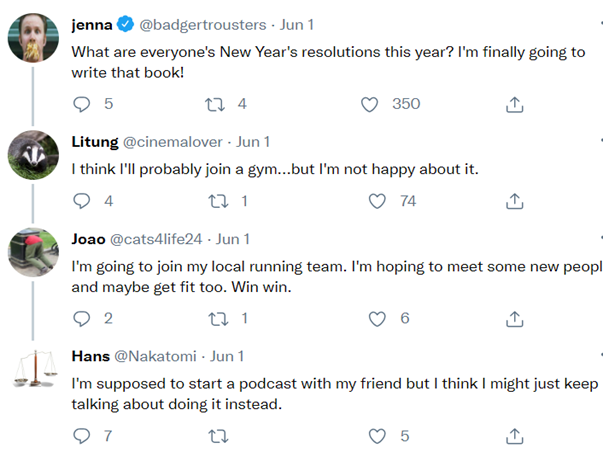
This lesson is obviously quite timely given the month but it very much focuses on analysing different future forms and highlighting how they are often used together. While the context is making resolutions on social media, the lesson goes on to show how these forms can be used in a range of different contexts.
Level: Pre-intermediate – Upper Intermediate.
Time: 90 minutes.
Objective: by the end of the lesson, learners will be better able to discuss their hopes and plans for the future.
Vocabulary focus: collocations for activities / hobbies.
Grammar focus: be going to / will / might / be supposed to.
I’m always interested in not just the language we use to communicate but the cultural ideas behind them. I remember the day that I learnt I had an understood sphere of acceptable personal space when I was communicating with others. I had just moved to Spain and was teaching 7-year-olds. Parent-Teacher meeting day came around and my Spanish was terrible. I had only been learning for 3 months. I worked hard and prepared my reports in Spanish with the help of my colleagues. I learnt them all off by heart and prayed that nobody asked any follow-up questions. One of my students, an amazing girl by the name of Lucia, was doing great in my classes but not so well in her English classes in her primary school. Understandably, but unfortunately for me, her mother had lots of questions.
She came in and caught me at the end of the meeting. I was standing in the corridor and she walked up stopping at a point that she felt comfortable and we began to have a conversation in my very broken Spanish about her daughter. My unconscious understanding of personal space kicked in and I took a step back. She then took a step forward and I took another back. By the end of the conversation when our odd dance had ended, I was 5 classrooms down the corridor with no idea how I’d gotten there.
From that point onward, I’ve been fascinated by all of the personal and cultural aspects of communication. It’s the little things that we assume is the same for everyone. But unless we discuss it, we often remain unaware that what is understood for one person or culture, can be offensive or shocking for another person. For that reason, I always had regular conversations with my students about how people communicate in their cultures. I never saw it as our job to teach this as such. More to facilitate that conversation so that our students can learn from each other and learn to communicative effectively with people from around the world.
This lesson focuses on greeting and encourages students to reflect on how they greet in their culture and to learn what others expect from a greeting. It’s designed for lower levels (elementary / Pre-intermediate) but as it’s an awareness raising lesson, it could be carried out with higher levels.
Intercultural Communication: Greeting
Level: Elementary / Pre-int (& above)
Time: 90 minutes
Objective: to raise awareness of how people greet in different cultures so that we can greet and have short conversations with people from around the world.
I absolutely love talking about food in class. I love how different cultures describe food, I love how literal some can be and how persuasive and descriptive others are. I love how totally convinced someone can be that the food from their country/culture is superior to another’s. I love the debates that ensue and all the language that emerges as a result. I love how curious everyone is off each other’s food customs. Food can be the gateway to lessons on question formation, circumlocution, descriptive language, instruction giving, debating and in the case of this lesson, writing skills.
This lesson focuses on describing food tastes and while the context is a food blog, the language (describing food and tastes) and the writing skill (organising a paragraph) are easily relatable to a range of speaking and writing contexts.
Details:
Level: Pre-Intermediate / Intermediate
Objective: by the end of the lesson, learners will be able to describe food tastes & write a paragraph that is easy for a reader to follow (e.g. in a blog post about food).
I wrote this lesson for a very simple reason. My friend sent me a photo of how his father-in-law drinks his coffee every morning and I just couldn’t get over it.
Every morning…every morning he drinks over a pint of incredibly milky coffee. I had so many questions and I kept thinking, I bet students would have lots of questions too. This is the lesson that followed.
Level: Elementary
Time: 90mins
Objective: Telling a story (e.g. about something you saw/did)
To make this lesson, I had to make a fake Instagram post and I came across my new favourite website. Great for making materials.
These days whether at work or in our personal lives, so much communication happens via social media messaging or texting apps. I can’t imagine my life without the ability to set up segmented groups of friends to organise events, work on projects or chat about inane interests.
We are big fans of using text messages for lessons for this reason but also because it is this beautiful hybrid of written and spoken English. More so than that, it is written spoken-English, which means you can easily teach or practise many speaking skills and conversation layouts in this more controlled medium of messaging.
Bringing text messaging into the classroom has many advantages. You can practise conversations at a slightly slower pace; it gives you more to feed back on as at the end of a text conversation, you can see everything that has been written, a luxury we aren’t afforded when monitoring a speaking activity; but above all, it mirrors real-life communication.
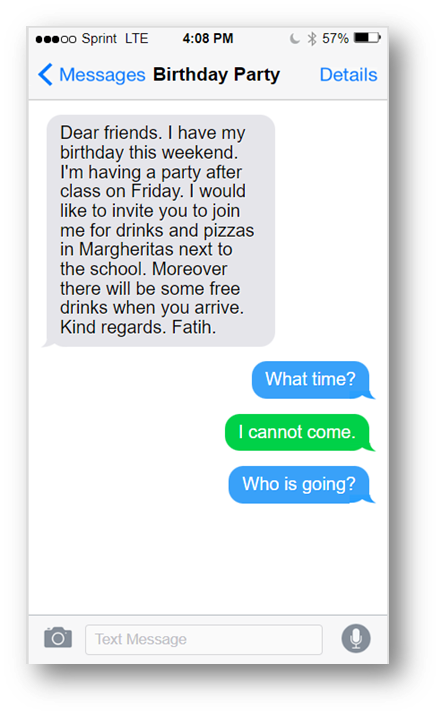
In this lesson we look at a common conversation of someone inviting a group of friends to a birthday event.
Let me start by saying I love Christmas. Absolute love it, can’t get enough of it. Keep that in mind when I say the following:
MY MOST HATED TIME OF THE WHOLE ENGLISH LANGUAGE TEACHING YEAR IS CHRISTMAS!
I can’t stand it. I have always hated teaching at this time of year largely because of my context:
Continuous enrollment: this means that half of the class have been in the school for months and are looking forward to some more relaxed lessons over Christmas as they wind down while the other half are only in the school for a few weeks and are keen to make every minute count.
Numerous teachers: most likely students studying for 3-4.5 hours every day will have a number of teachers and are likely to have several people trying to do Christmas lessons with them.
For these reasons I made the decision many years ago that no matter the holiday, I was going to teach the same as any other day of the year. Sure, I might use the holiday as a topic but no more than that. This means no questionable gapfills of Jingle Bells or scenes from Love Actually with tenuous objectives, and definitely no bringing in the Winter Wonderland song and trying to make sense of the madness that is “in the meadow we can build a snowman and then pretend he’s Parson Brown”. Who in the name of the wee man is Parson Brown?!
But I digress…
So yes, that’s right, I am saying that I am the EFL Christmas Grinch, stealing relaxed Christmas lessons from my students and colleagues.
But worry not, I am not completely without heart. As I said, I do embrace the holiday as a topic in my lessons so here are 2 for you if you decide to go down the EFL Christmas Grinch route.
This lesson instead looks at persuasive language as well as offering students the chance to practise listening and giving natural responses.
Why 12 Angry Men? I have wanted to write a lesson using this clip for about 3 years and with the current political climate, this seems like a good moment to look at a clip which demonstrates prejudice. I find this clip optimistic in that most of the jurors move away from the speaker. Anyway, I digress. We were both impressed by a session given by Angelos Bollas (Dublin: 2018) on using materials that are emotionally engaging and hope some of that has filtered into this.
Time: 2hr
Level: Intermediate (B1) and above
Aim: to look at persuasive language and structuring a response
Show the clip with the sound off and ask the students what they think is happening? What makes the men stand up one by one and walk away from the table? This is to generate interest and pique their curiousity.
Listening:
2. This task relates back to question in pre-listening – giving a reason to watch and a chance for those who are stronger to identify the issues with what the speaker is saying.
In terms of answers you might want to let them know that it is the jury in a trial
3. This is more detailed and is looking for the following answers or similar. (However, if you think other answers work, go with it.)
Who has been accused and of what? – a kid (probably can infer murder)
What is the speaker’s attitude towards the case? clearly prejudiced against the kid and ‘others like him’
What do the rest of the juror’s think about what he is saying? again you can infer they disagree by walking away in peaceful protest
How does the speaker react when he is told to stop talking? Bemusement – defeat
Natural Response:
This section is meant to promote discussion in a lest gist orientated fashion. Allowing the students to analyse the text discuss it.
Is there any language here which is used to generalise a group of people? phrases like “you know how these people lie” “it’s born in them” “They don’t know what the truth is” “they don’t need any real big reason to kill someone either” “they get drunk”
Why might that be a problem in a trial? Clearly this speaker isn’t impartial
Do you think the speaker is racist? clearly this is contentious, but acting like this could definitely be considered as ‘Cultural racism’
Persuasive Language:
This is just a simple matching task
1 = H 2 = F 3 = D 4 = B 5 = I 6 = G 7 = E 8 = A 9 = C
2. The following techiques were used in the speech
Techniques: 1 2 3 4 7 9
Responding and debating: the rebuttal
The point of this is to give the students some chance to respond to the speech used in the clip by recording their own version. You could hold class discussions on suitable topics to include. The main aim is to get them to record a response that you can check and to use the check list.
The two methods of beginning are by no means the only options, but should give the students some help in starting. If you have others you prefer, please use them.
What do you think are the advantages or disadvantages of both?
Concession – advantages deflames situation / disadvantage could be that it implies a degree of agreement
Refutation – opposite to above.
Your response:
Give students time to plan. Let them think of arguments (claim and evidence) to help them in their short response.
Setting Success Criteria: When you mark these, tell the students in advance exactly what you will be checking for. If you are looking for structure, do not only correct them on their grammar or pronunciation. The checklist is here to help with structure, but depending on the needs of your class you could negotiate others with them. Or, in mixed ability classes even for each student.
Extension activities:
After feedback, students rerecord their response focusing on one or two points highlighted.
You could ask your students to read this review and again look for persuasive devices featured in the lesson or any of the myriad of ideas for reviews you would normally use
Alternatively, you could ask your students to look for any examples of cultural racism and the generalising of different nationalities into negative traits.
These are interesting times we live in. Interesting in that the entire world has been turned upside down but also interesting in terms of how quickly we have all adapted. One thing I’ve found interesting is all of the new lexis that has just snuck into daily use. I don’t think I’ve ever said the word “furlough” before and suddenly the UK government used it one and now I say it 10 to 15 times a day.
This lesson aims to look at some of the new lexis we’ve adopted as well as what I’ve been calling “checking in”. In this Covid era, the words “how are you?” as a greeting are a bit redundant. We know people are not great. Instead we’re seeing questions like “How are you doing?”and “How are you coping?”, meaning “I know it’s gone to crap but how are you surviving?”. With everyone stuck in their homes, online communication is our key form of communication so this lesson uses chatting.
As most of us are teaching online, I’ve chosen to use PowerPoint instead of a handout and I’ve put some notes on the slides instead of a standard procedure.
Level: Intermediate / Upper Intermediate
Time: 60-90 minutes (depending on what activities are done outside lesson time)
This one is quite grammar heavy but there are a lot of skills in there as well. The biggest one is analysing grammar in context and this lesson draws heavily on Danny Norrington Davies’ idea of asking students “why” a particular language point has been chosen in this particular situation. We’ve really found that doing this little and often encourages our students to ask the same question of the language in the world around them.
Try it out and let us know how it goes.
Level: Intermediate / Upper Intermediate
Time: 90mins – 2 hours
Age: Adults
Objective: To be able to write an engaging invite to an event
Material:
This time for the material, I’ve gone with a presentation instead of a worksheet. I’ve tried to make the slides as intuitive as possible but let me know if you have any questions.
It’s been a while since we have put any new lessons up but for a very very good reason, which will become apparent in about March 2020.
I couldn’t resist putting up a Christmas lesson and what better to focus on around this period but memories. I know there are many who don’t celebrate Christmas so while this lesson focuses on a Christmas memory, the skills and language that will be learnt can be used for any regular public holiday or festival memory.
As with some of our other lessons on memories, this one focuses on how “used to” and “would” are used together but this one also adds in one-off memories as well.
If this one isn’t enough for you, you can find the previous “used to” lessons: here and here.
Level: Upper intermediate & Advanced (could be easily adapted for Intermediate)
Objective: by the end of the lesson, you will be better able to describe childhood memories

 textploitation