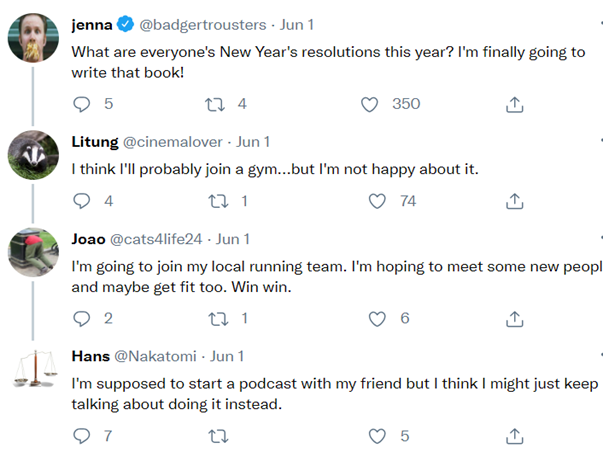
This lesson is obviously quite timely given the month but it very much focuses on analysing different future forms and highlighting how they are often used together. While the context is making resolutions on social media, the lesson goes on to show how these forms can be used in a range of different contexts.
Level: Pre-intermediate – Upper Intermediate.
Time: 90 minutes.
Objective: by the end of the lesson, learners will be better able to discuss their hopes and plans for the future.
Vocabulary focus: collocations for activities / hobbies.
Grammar focus: be going to / will / might / be supposed to.
Over the past few months, I’ve been speaking to a lot of teachers about the emergence of AI and its impact on our industry. Reactions have ranged from fear to acceptance to excitement. It’s a really interesting time to be a teacher. I have to say, I understand the fear. For the majority, it’s not about machines rising against us or homicidal interactive whiteboards. For many it’s a fear of the unknown, we just got used to teaching online and now there’s another new piece of software we need to get to grips with, another tool that our students will be more familiar with than us. And that is very understandable.
In answer to that fear, I would say just try it out. Start small and take it from there. You don’t need to be the expert. It’s all about the first step. In this post, we’ll look at making that first step as easy as possible.
What problem can AI help to solve?
An easy first step is finding something you do regularly and explore how AI can help you achieve that more effectively. As a teacher, I remember spending hours scouring the internet looking for the perfect texts to use in my lessons, the perfect dialogue, story, article, etc. I’d come across one and it would be almost perfect but not quite. If you’ve ever had this issue, Artificial Intelligence is going to become your best friend.
For the purposes of this blog, we’re going to use Chat GPT. It’s free, easy to sign up to and easy to use.
What is the objective of your lesson? What kind of text would help you to achieve that objective? Is it a short story, an article, an anecdote, a poem, a dialogue, a text conversation? Whatever it is, Chat GPT will help you to write it.
Step 3: Get your prompt right
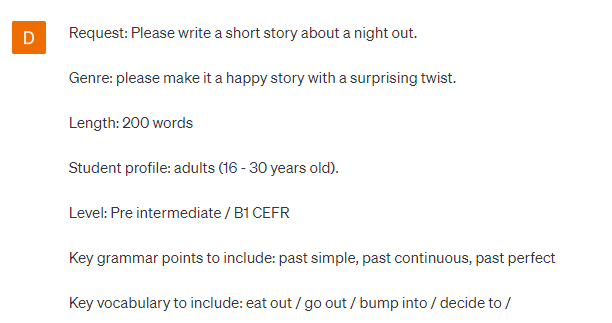
The key to getting the text you want is feeding Chat GPT the information it needs. For example, if you say “write me a story about a night out”, you might get a story that’s 1000s of words long or you might get a very short one. It might be a love story, a horror story, or a combination of both. You’re at the whim of Chat GPT. It’s all about the prompt. To ensure success, include:
Request:
Genre:
Length:
Student profile:
Level:
Key grammar points to include:
Key vocabulary to include:
Step 4: Edit your text
The beauty of Chat GPT is that if you don’t like your text, you can just click “Regenerate” and you’ll immediately get another version. You can also ask Chat GPT to refine your text by feeding it further prompts. For example, you could say: “please make this story shorter” or “please make the vocabulary a little simpler” or even “please rewrite this story in the first person”.
In my experience, you’ll probably still need to edit the story slightly to make it perfect for your specific group of students, but Chat GPT will do most of the heavy lifting for you and will do it in seconds.
Let’s look at an example:
I want to teach a lesson on telling stories using a range of narrative tenses. My topic is nights out. I asked Chat GPT to create a text for me. Using the prompt structure above, I fed it the information it would need.
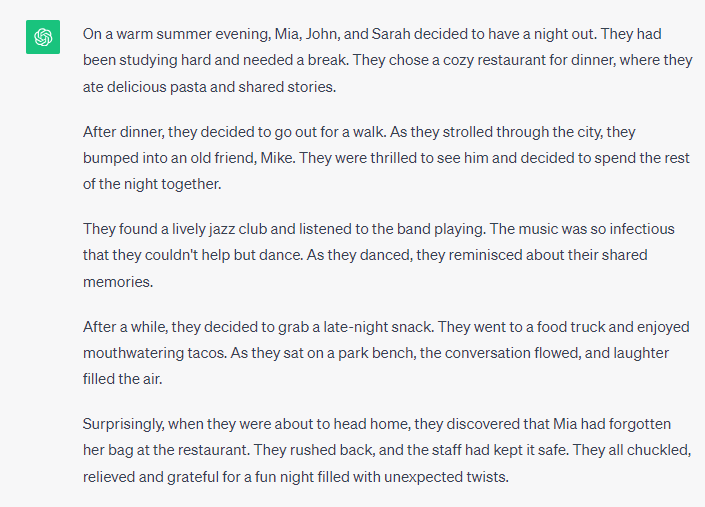
Chat GPT created the story below, which is a pretty good start but I felt there was some vocabulary that wasn’t really appropriate for this level.
I asked Chat GPT to replace the vocabulary with simpler vocabulary and got the following. This was pretty good but I wanted my students to tell their stories from the first person to better mirror how they tell stories in their real lives.
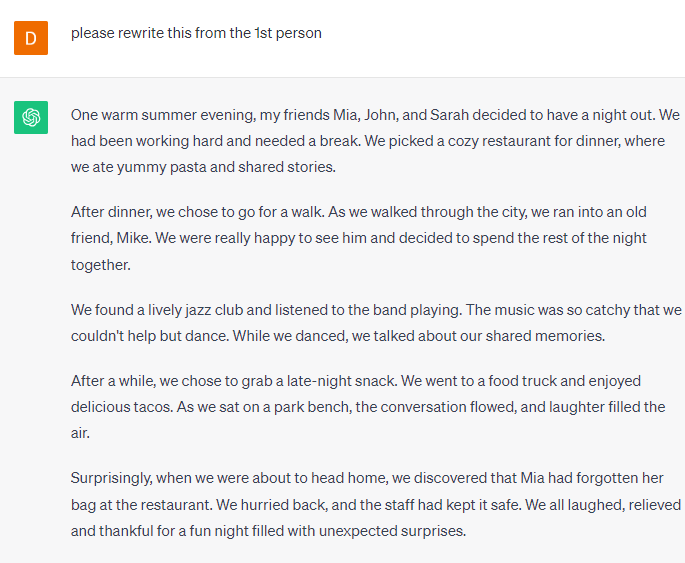
I asked Chat GPT to rewrite it from the 1st person point of view and thankfully it obliged.
I’ve now got a pretty decent text, at the level I want, in the format I want and the beauty of this is that it took about 2 minutes from start to finish.
A Final Thought:
AI isn’t perfect in any shape or form but it can save you a lot of time when it comes to lesson planning and materials creation, even if it’s just to give you some inspiration. So, before you go scouring the internet for the perfect text, why not take that first step and give AI a go. It’s not as scary as it might seem.
I absolutely love talking about food in class. I love how different cultures describe food, I love how literal some can be and how persuasive and descriptive others are. I love how totally convinced someone can be that the food from their country/culture is superior to another’s. I love the debates that ensue and all the language that emerges as a result. I love how curious everyone is off each other’s food customs. Food can be the gateway to lessons on question formation, circumlocution, descriptive language, instruction giving, debating and in the case of this lesson, writing skills.
This lesson focuses on describing food tastes and while the context is a food blog, the language (describing food and tastes) and the writing skill (organising a paragraph) are easily relatable to a range of speaking and writing contexts.
Details:
Level: Pre-Intermediate / Intermediate
Objective: by the end of the lesson, learners will be able to describe food tastes & write a paragraph that is easy for a reader to follow (e.g. in a blog post about food).
I wrote this lesson for a very simple reason. My friend sent me a photo of how his father-in-law drinks his coffee every morning and I just couldn’t get over it.
Every morning…every morning he drinks over a pint of incredibly milky coffee. I had so many questions and I kept thinking, I bet students would have lots of questions too. This is the lesson that followed.
Level: Elementary
Time: 90mins
Objective: Telling a story (e.g. about something you saw/did)
To make this lesson, I had to make a fake Instagram post and I came across my new favourite website. Great for making materials.
I remember my first teaching position. It was 2009. I walked in the door, was handed a coursebook, a register and some CDs and told to head across the road where my classroom was. There I found an old building with several classrooms and no teachers room. Over the next six months, I learnt to teach from the only support I had, which was my coursebook.
Let me stop for a second to say that coursebooks are wonderful. I love them. But in an industry in which many teachers at best have a four-week course under their belt and at worst begin teaching with no relevant qualifications to speak of at all, coursebooks play a huge role in shaping and influencing the type of teachers we become. This is not a role that should be taken lightly.
What did I learn in those first 6 months?
I learnt a lot. I learnt that grammar was the key to learning a language. Every unit was built around the grammar. The point of the lesson was to teach the grammar. I learnt that being a good teacher meant learning all the grammar and presenting it in an interesting way.
I learnt that teaching listening meant carrying out a comprehension checking activity. From unit after unit of comprehension checking activities I learnt that practice was supposed to make perfect. I learnt that a good teacher constantly tested their students’ listening comprehension.
I learnt that teaching meant covering information. It meant completing the reading and listening activities. Doing the vocabulary exercises. Teaching the grammar. Practising it in gap-fill exercises and speaking tasks.
How do I feel about those lessons I learnt?
Well, over the past decade I’ve spent my time teaching, researching, attending conferences and chatting to colleagues and I’ve learnt that maybe not everything above had a positive impact on my students’ progression. I’ve had to gradually unlearn a lot of those potentially damaging lessons.
I’ve learnt that presenting the grammar in an interesting way doesn’t necessarily mean my students are any better equipped to use it when it counts.
I’ve learnt that being a good teacher doesn’t just mean mastering all the grammar points.
I’ve learnt that practice does not necessarily lead to perfection when it comes to listening.
I’ve learnt that a successful lesson doesn’t mean covering information, it means helping your students reach a goal. A successful lesson is one in which your students know what that goal is and can both see and discuss their progress.
I’ve learnt that giving my students input means nothing without them having the opportunity to reflect on what they’ve learnt and how they can use it in their lives beyond the classroom.
I’ve learnt that teaching isn’t about me, it’s about them.
Haven’t coursebooks changed too?
Coursebooks play a valuable role in our industry. As mentioned above, they can choose to drive standards and challenge outdated norms of teaching. In my time in the industry, I’ve seen huge changes.
The lexical approach was not new when the Outcomes series was released but because this approach was now visible on the page, gradually teachers who used these books were learning a new way of dealing with language and grammar in the classroom.
With the release of the Voices series, countless teachers around the world are now incorporating inter-cultural communication into their lessons because it is there on the page.
It is amazing to see new coursebooks coming out and paying attention to the changing world of language learning. As we see fewer coursebooks with pictures of London buses and tube stations in every unit, gradually English language learning becomes less England-centric and focuses more on global English.
But is there space for anything else on the page?
Our industry has come so far and it’s incredible seeing how materials have changed and grown over the years. However, I believe there is still space on the page for discussion. Not just the discussion of content but the discussion of learning.
Many teachers may be having these discussions with their students, but that can be a lot to ask of newly qualified teachers. By giving the below space on the page, we highlight their importance and give both teachers and students the tools they need to discuss learning and impact.
Real-life objectives.
Clear aims.
The discussion of the aims and objectives.
The creation and discussion of success criteria.
Reflection tasks.
For more information on each of these areas, check out our blog on Overt Teaching or our book on Overt Teaching. If you’re interested in materials that put the discussion of learning on the page, try this low-level lesson on using the past simple to tell stories. This worksheet includes aims and objectives, discussion of these aims, success criteria and reflection on progress on the page.
I was in a school recently chatting to a teacher and I keep going over something they said. I can’t get it out of my head so I thought I would write a cheeky blog and see if I could pick it apart.
I don’t give writing homework because then I just have loads of writing to mark.
I think we’ve all expressed similar sentiments over the years. After all, when you factor in planning time and post-lesson reflections, and CPD, and admin, a large pile of writing submissions doesn’t seem super appealing. And, while I was obviously frustrated that this issue was stopping students from getting writing practice and feedback (more on this later), it wasn’t this sentiment that stuck in my mind. It was the word “mark”.
Below are the questions, I would like to consider in this post. In the discussion that follows, I am considering General English classes as opposed to specific writing courses, EAP, or Exam Skills classes.
What do we actually mean by “mark” when it comes to a piece of writing?
Should we be marking our students’ writing?
What feedback should we be giving them to encourage development?
Can we somehow save ourselves from doing all the work?
What do we mean by “mark”?
I think what the teacher and our industry in general means by marking a piece of writing is one of two things.
Highlighting and correcting the student’s errors.
Indicating errors and the type of errors and encouraging the student to correct them, or rewrite it without errors.
When I was a slightly younger man, I was learning Spanish, and I was a proper beginner. Outside of “hola” and “una copa de vino por favor”, I was pretty useless. I decided to start by learning some key verbs I might want to use, and seeing as how I liked writing I chose to write a story. It was not a good story by any stretch of the imagination but man, I was proud of it. “Andy y los Animales” it was called. A single paragraph about Andy and the myriad animals he had, allowing me to use a range of verbs and a lexical set of animals I’d just learnt.
Like any good student, I wanted some feedback so I gave it to my then girlfriend to mark. Well, Jesus, I have never been so demotivated in my life. I got a back a paragraph covered in green (she’d been kind enough not to use red) underlines and corrections. Some errors she’d left for me to correct. What did I do? I thanked her, popped it in the back of my notebook, never looked at it again, and went off to eat jamon and queso in an attempt to quash the feelings of demotivation I had. To this day I haven’t written another story in Spanish. Sad but true.
What did I want in that moment? I’m not entirely sure but I think I wanted some positivity and something manageable that I could improve upon.
If you take the marking approach to writing feedback, take a minute to reflect on these questions:
Have you ever received similar feedback to the story above? How did you feel? What action did you take? Was it developmental?
When you mark your students’ work, do they take it on board? Do they submit corrections or rewrites?
Should we be marking our students’ writing?
I think it is clear from the story above, where my feelings lie but I want to think about this from another side. When we correct our students’ errors, are we actually marking or are we editing? I would argue the latter. Editing is a specific skill and something that people pay for. What do our students pay us for? It’s not an editing service. I would say they pay us to help them develop their English language, and learning skills. When we mark or edit, do we achieve this? I would argue no.
What kind of feedback do students want?
Well, that depends on the task itself. Before any feedback is given, everyone in the class (including the teacher) needs to be clear on the point of the exercise.
Writing for Fluency
If the aim is to encourage a love for writing, or merely to encourage students to write more, then feedback should reflect that. One example of this would be asking students to write a message and then replying to that message naturally without highlighting errors. Development can come later by identifying common writing skills or linguistic issues and dealing with them in class at a later point.
Writing as a vehicle for language
Very often writing is used as a vehicle to test language that has been learnt in a lesson or over a number of lessons. Feedback in this situation only needs to focus on the language that has been learnt and should not on other areas of writing or language that arise. Again, these can be focused on in later lessons. As this is all learnt language, there should be no need for a teacher to correct the language. There is an expectation from learners that they are being assessed on their use of specific language and that they will have to correct it. The content is more or less meaningless as long as the language is used correctly.
Practising a specific writing skill
If a specific skill has been developed in class, then obviously writing practice is the way to asses it. Maybe the teacher has taught their students about referencing, avoiding repetition, organising a text, writing a cohesive text, writing an effective paragraph, or any other writing skill. In this situation, the feedback can focus entirely on how successful the student has been with this skill.
Can we save ourselves some work?
I still understand the teacher who doesn’t want to set writing. They were starting from the point of view that their job is to edit their students’ work, or facilitate an edit by highlighting all the errors. However, as seen above, if the aim is to engage students and see development in a specific area, then feedback can be focused and doesn’t have to be extensive.
That said, even when it’s focused, feedback still takes thought and time. And, it is flawed as the responsibility is still on the teacher to identify any issues. Don’t we want our learners to be identifying their own issues and dealing with them before the piece of writing gets to the teacher?
Creating an extra line of feedback.
As mentioned above, the key to setting up a writing task effectively is that everyone knows what is expected of them in the task and what feedback they will receive. In the examples given above, a single area of language or a single skill are being practised/assessed. However, very often teachers will want to practise a number of different skills and language points at once, in a single cohesive piece of writing.
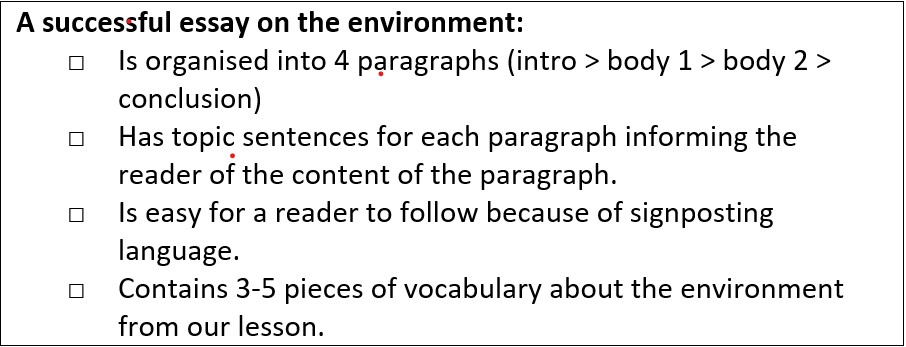
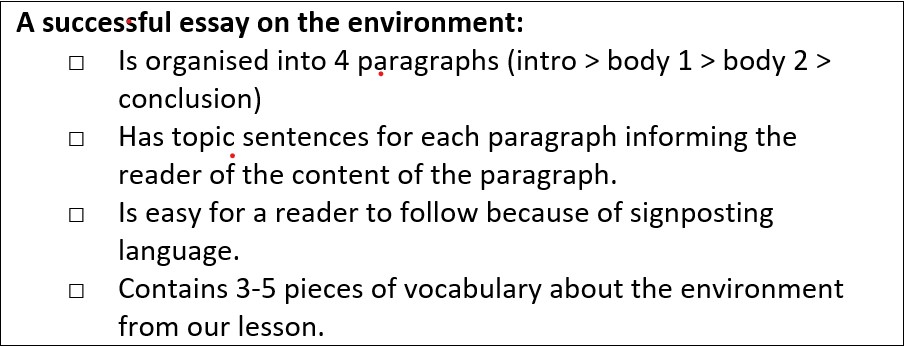
The fact remains, clarity of expectations is key. Clear success criteria enable students to assess their own writing and that of their partner’s before it reaches the teacher. Imagine a class in which students have learnt to write an essay on the environment. They have learnt to organise an essay, to write topic sentences for each paragraph, and to use sign-posting so that it is easy to follow. They have also learnt a range of lexical chunks related to the environment. In this class, the teacher provides their learners with the success criteria below:
Because of the clarity of the criteria, students can assess their work and their partner’s, giving each other feedback and upgrading their writing before handing it in. This can happen inside class time, making it even more likely that rewrites and edits will occur…and it saves a bit of time outside, which is always nice.
Conclusion
Sometimes we all get wrapped up in this is what we do and this is what it’s called. I think it is important that we challenge these norms and if they don’t hold up, then it’s time to put them in the bin. Is there a place for marking? Probably, but I’m not sure it’s a General English classroom. We’re teachers, not editors.
Recently I wrote this post on aims and objectives and as always with this topic, there will be those that agree and those that disagree. It really seems to polarise our industry in a way that it doesn’t seem to in K-12 teaching (or at least that I’ve come across). I thought it would be interesting to think about that and consider some of the common arguments against knowing and communicating what you want to achieve and it seems to me to boil down to one main issue. The belief that:
Having aims and objectives locks us in and an English language lesson should be free to go wherever the students need it to go.
Now, there are a lot of things I could pull from that. The two sides of the Great Objective Debate could spend hours arguing back and forth with neither giving any ground, like academic Brexiteers and Remainers. But where would that get any of us.
Instead, I mentioned it to my wife and she mentioned that in her industry (grant-giving/management in the charity sector) they always have clear objectives for a project but afterwards they like to sit down and carry out an activity called outcome mining in which they pull out and discuss all of the unintentional outcomes they achieved throughout the project. And as she said it, I wondered if maybe this was a bridge between the two camps.
I in no way believe that one should teach their aims/objectives blindly without thinking about the students in front of them or dealing with interesting language that comes up as a matter of course. I fully believe that the job of the teacher is to react and manage what happens in front of them, ensuring that what they’re teaching is relevant and accessible for the specific students in front of them. But I also believe they (and their students) should know from the beginning of the lesson what they are trying to achieve.
Maybe the perfect world is:
Knowing what you want to achieve
Communicating it to your students and discussing how you intend to achieve it
Being open to your students wanting to achieve it in a different way
Being open to unintended outcomes that arise throughout the lesson
Spending time at the end of the lesson reflecting on:
So, the mad rush to get online has subsided. The barrage of webinars on how to set up breakout rooms on Zoom have ended and the conversation is turning once again. It’s crazy to think all of this only started a few short months ago. It feels like days ago that our teaching context was turned upside down and we scrambled to bring our courses online and now, with restrictions being lifted in various countries around the world, it looks like it’s all about to be turned on its head again.
The question on my mind is:
what does the post-covid classroom look like?
Now, I’m not talking about 2022 when all this is done and dusted (fingers-crossed, touch wood and all that lark) and we can go back to the way things were before. I mean the classroom between now and then.
Many schools will take a blended approach, carrying out some lessons in a physical classroom and some online. Undoubtedly, we will have smaller class sizes. Schools will consider staggering start times and closing public areas. Hand sanitiser will, of course, feature heavily in any reopening. Depending on government advice, masks might be a pre-requisite or they might be discouraged. Depending on your country, your borders might be open to new students and there may / may not be a quarantine period.
But let’s assume that all the above has been taken care of by school management and the government. Where does that leave you, the teacher, when it comes to your face to face lessons in a physical classroom? Is it business as usual but with fewer students?
I don’t think so.
Let’s take a close look at our teaching toolbox, our tried and tested techniques, the bread & butter of teaching in a communicative classroom. What happens to them in a socially distant classroom?
Pairwork: sadly, this is probably done and dusted for a while. We won’t be casually leaning over and checking answers.
Group discussions: Unless it’s a whole-class discussion, which has its limitations, we won’t really be able to conduct group chats with a metre between each person.
Hand-outs: You won’t be moving around the classroom giving your students a beautiful photocopy. Depending on school guidelines, you might not be able to give any material that the student didn’t bring with them.
Monitoring: while it won’t be impossible to monitor, sneakily looming over a student’s shoulder and offering advice & encouragement is going to be frowned upon.
Unfortunately, a socially distant classroom is going to leave us without our go-to teaching techniques but all is not lost. If we’ve learnt anything over the past few months, it is how quick our industry is to adapt to the situation and adopt new techniques that better suit the circumstances we find ourselves in.
Adapt and adopt, we shall.
When deciding how to adapt, we must consider what we are losing and how we can try to replace it.
Mentimeter:
One of the main reasons, I use pairwork in class is to give students thinking time, to allow them to learn from each other and help each other to formalise their opinions before they bring them to the class as a whole. Often, having a moment to share an answer with a partner will give a student the social reassurance they need to then share it with the whole class. This is the beauty of pairwork and something we really don’t want to lose.
One way to give students the thinking time, to give them confidence in their answers without having to share them with the whole class is by using poll / survey websites like Mentimeter. It allows students time to think and to answer anonymously; they can very easily see how the rest of the class feels or is answering and then stand by or alter their answer before bringing it to the whole class. It encourages the quieter student to get involved and gives them an easy communication avenue.
Text Discussions:
Much of how I communicate is via text messages or social media. There are people I speak to regularly that I haven’t talked to in person for years. This is the same for many of our students yet in a communicative classroom we tend to focus on speaking. Most schools will by this time have chosen an online platform to deliver their lessons be it Teams, Zoom or something else. For Zoom, students could simple start a meeting, turn the cameras & audio off and use the chat box.
By using these same tools or even WhatsApp, students can still carry out discussions in a meaningful way before sharing the outcome of their discussions with the rest of the class in whole-class feedback.
The nice little by-product of these types of discussions is a written record. The chat box can easily be screenshot and shared. Students can reflect on what they actually said/wrote and analyse how well they used the target language. And you have a concrete source to reference for feedback.
Displaying:
If handouts are behind us, that’s no bad thing. They’re great, don’t get me wrong, but the environment won’t thank us for all of the dead handouts that ended up in bins around the EFL world. In the socially distant classroom, we will be forced to abandon them and use the tools we have. So what do we have?
IWB: many of us will have an IWB. Apps like Microsoft Lens allow us to scan in resources; the snipping tool allows us to chop them up and deliver them to our students one piece at a time…as the writer no doubt intended.
Phones: our students don’t need to have a piece of paper they never look at again, they have cameras. Cameras that save photos in clouds according to their dates. Photos that they can access forevermore without having to sift through crumpled, wrinkled, ragged remnants of lessons long-forgotten.
If we don’t have IWBs, we have phones, which means we can send photos / documents via online platforms, WhatsApp, email, etc. Our learners can zoom in, they can edit, they can engage with it however we see fit.
Support over Presence:
Something that I’ve really found in online teaching is that support is more important than presence. In the past we have relied upon the fact that we can monitor closely and be on hand to answer every little question. In breakout rooms, this became impossible and in a socially distant classroom it becomes trickier.
All this means is that we need to spend more time setting up an activity. Learners need to know what exactly they should be doing, why they are doing it and what success looks like. Instructions are more important than ever and checking instructions is crucial. With students potentially working more individually or on their phones and you unable to loom over their shoulder, checking they are on task becomes more challenging. The answer may be to spend more time on giving and checking your instructions and getting buy-in for the activity from the students.
Above are just a few of the issues we may face in the socially distant classroom. No doubt there will be others that we haven’t even considered yet. Some of the above ideas for coping with these issues may turn out to be unworkable depending on your teaching context but we have proven our ability to adapt and adapt we will. I am excited to see how we tackle these issues and to hear your ideas.
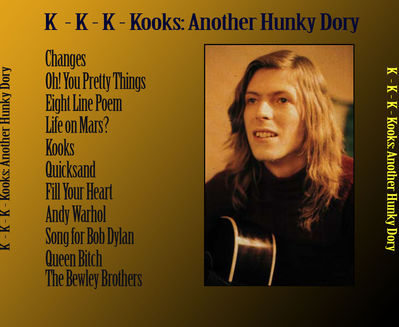
Look, the fact is we just can’t resist a Bowie lesson. There it is, plain and simple (If you missed our previous one, you can check it out here) and I can’t promise that this one will be the last Bowie lesson we ever do. In fact, I can almost guarantee you that there will be more. This one came about because I was listening to Hunky Dory and got a wee bit obsessed with the song, Kooks. I thought I’d share it with you.
It’s a simple enough lesson using a song to look at vocab, “will” and connected speech. I’ve always felt that songs are a great way for students to practise their listening as they’re usually in quite natural speech (not always) and in real life there is very often background noise that you need to filter out when you’re trying to listen. Songs replicate that quite well. This is something I always point out to my students when I do a song. I think it’s important they see the benefit and don’t just think that songs are something we do on Fridays for fun.
Objective: to raise awareness of connected speech in songs / to examine different uses of “will”
So we finally have it, Barry London’s second official lesson. If you haven’t seen the previous one it’s right here. The idea we came up with was that seeing as how for some reason every character in my lessons is called, Barry, we’d just embrace this and create a person and give him a string of lessons. They’re for different levels and will look at different aspects of the language. Also, they do not need to be done in any sequence. They do not build on each other.
This one is very different to our normal lessons in that it looks at descriptive writing and study skills in more detail than we normally would. It started out as a low level lesson but it was most definitely a high level one by the end.
I’d recommend this lesson as something different to do at the end of the week or course or for more creative students. It’s definitely not a straight grammar lesson.
Level: Upper Intermediate / Advanced
Time: 2 – 3 hours
Objective: to encourage sts to record language in context and to think about metaphors and imagery in creative writing.





 textploitation