Barry London: Writing + Study skills

Brixton-Tube-CLosed

So we finally have it, Barry London’s second official lesson. If you haven’t seen the previous one it’s right here. The idea we came up with was that seeing as how for some reason every character in my lessons is called, Barry, we’d just embrace this and create a person and give him a string of lessons. They’re for different levels and will look at different aspects of the language. Also, they do not need to be done in any sequence. They do not build on each other.

This one is very different to our normal lessons in that it looks at descriptive writing and study skills in more detail than we normally would. It started out as a low level lesson but it was most definitely a high level one by the end.

I’d recommend this lesson as something different to do at the end of the week or course or for more creative students. It’s definitely not a straight grammar lesson.

  • Level: Upper Intermediate / Advanced
  • Time: 2 – 3 hours
  • Objective: to encourage sts to record language in context and to think about metaphors and imagery in creative writing.

Materials:

  1. Barry London arrives in London – teacher’s copy – Answers / notes
  2. Barry London arrives in London – student copy WORD
  3. Procedure Barry London story – Procedure
  4. Barry London arrives in London PDF -student copy PDF


For Shame Ryanair: Error Correction

This is not so much a lesson as an idea for using what is around us as the beginning or end of a lesson. Done little and often, it could really make a difference.

As an English teacher you’ve probably had that moment when you read your friend’s Facebook messages and despaired at their shocking inability to use “their”, “there” and “they’re”…and these are native English speakers.

The fact is none of us are perfect and I only found out the other day that little things got my “hackles up” and not my “heckles up” like I’d thought for years…that was embarrassing.

Mistakes are all around us and one way of encouraging your students to correct errors in their work and that of others is to highlight this fact whenever possible. One option is to bring in Facebook comments or the comments from online newspapers.These are often chock-full of interesting little mistakes. Personally, I like to take pictures of any signs I find with errors on them. Sadly, in London these are everywhere. This one I actually found whilst flying over the Irish Sea on a Ryanair plane.

Ryanair needs to think long and hard about their use of hyphens. Check these pictures out and ask your students what the difference between “on-board” and “on board” is.


 For more on the errors all around us, check out this lesson on Nando’s.

I was in the same restaurant the other day and noticed yet another legend on the wall, once again riddled with missing words and spelling mistakes…come on, Nando’s, have a word with yourself.

Paint it Black – Listening lesson

I wrote the ‘tense review with the stones’ lesson a couple of weeks ago:

Tense review with the Rolling Stones

and here, as promised, is the follow up!

It is intended as a short follow up, so shouldn’t take too long, but focuses on listening and picking things out from the song.

Rather than picking this song for its specific merits, I picked a song I liked and then looked for what was there.  Hopefully some of the ideas here can be applied to songs you or your students like too.

enjoy,

now where is my black paint?

Level: Int (and surrounding levels)

Procedure: A lot of this is just following the worksheet.

Discussion: – warmer – associations with the colour black, think about collocations as well, get as much as you can from the students.

Listening: Play the song twice or as many times as needed for students to complete the table.

Answer – the girls are walking by – not painted or want to paint

Grammar: Highlighting causatives

follow the exercise, you could always revise this later in the wk / class.  This is more a case of exposing students to it, getting them to think about it and showing them that get can also be used.

Vocab: Here you can either do this as a reading or a listening, but I would go for a listening and then read to check.

Once they have completed the phrases put them in groups and ask them to work together to think about the meaning.

Check it as a class.

Pronunciation: This section is just to draw attention to natural features, something that we think is important for students to enable them to listen well outside the classroom.

You could drill them and ask them to think of other words that like ‘happening’ are written with what seems like 3 syllables but often pronounced with 2.

For the linking /j/ you could follow this up with the maze activity from pronunciation games by Mark Hancock.

Click to access 5-Link-Maze.pdf

Materials: 

Word: Paint it Black worksheet

PDF:   Paint it Black worksheet

Song without lyrics: https://www.youtube.com/watch?v=fPVUa29kHu8

Song with lyrics: https://www.youtube.com/watch?v=O4irXQhgMqg


Low-level Past Simple Story Lesson

THE WAKE-UP CALL

I’ve been working out of New English File Elementary recently and it’s a great book but as often is the case with a book, it never really 100% gets the challenge right for your particular group. Sometimes it’s too easy, sometimes it’s too hard. At the moment it’s a smidgen too easy for my group and we are absolutely motoring through it.

This lesson was basically a bit of an extension after we’d studied the Past Simple in the coursebook. It’s got some revision and it pushes a bit extra as well. We’ve also been talking a lot about language chunks / collocations / pieces of language / items of lexis (whatever you want to call them) so it looks at that a bit too.

Plus, it gets them using their imagination a little bit too, which never hurts…unless they say, “teacher I don’t have an imagination” and then we despair, oh yes we do.

  • Level: Elem / Pre-int
  • Time: 3 hours
  • Procedure: see below

Materials:

  1. Wake-up call (word worksheet)
  2. Wake-up call pdf (PDF worksheet)
  3. Wake-up call procedure
  4. Wake-up call – teacher’s copy


TIP: So, I’ve been teaching a lot of low level classes at the moment and they’ve been mostly smaller groups (2 – 4 students). One thing I’ve found is that when the group is this small, any worksheet or coursebook you break out means utter silence as they disappear into its depths. Or, it’s awkward because they’re too aware of you.

One way I’ve found of avoiding this is writing my worksheets up on the board, more or less how I’d have them on the sheet.

the students go up and work on the board as a whole or in pairs on different sections and you monitor from behind them. It really makes a difference.

you can always give them the worksheet afterwards. Here’s a pic of my board for this lesson. You might notice there are some mistakes on the board. Their first task was to correct the errors and then later I gave them the worksheet with the corrected version to check it, which is a slight variation on the procedure above.

Here’s a shot of my board. I like to think that my distinctive cursive script adds an extra layer of challenge to the lesson and is, of course, completely intentionally awful

wake up call boardwork

Editing Texts – Exam Classes

I don’t know about you but I have had awful trouble in the past, trying to get my exam students to think beyond grammar and spelling when it comes to editing texts. I completely understand it, every writing exercise they’ve done in every language class ever has essentially been a language test and nothing more. Most of our correction keys (if we even use them) revolve around language errors and maybe paragraphing if they’re lucky. Then suddenly they rock up to an exam class and we start banging on about style and register.

Luckily, my girlfriend produced this email from her inbox the other day. And what a treat it was. Having kindly ordered some toys for our cat (in the hopes that it would play with them and not our ankles or toes) online, she patiently waited for a month before saying: “ehhhh…China, where are my toys?”. She received the email below. And it is fantastic!

cat toys

This is a quick and simple lesson, using a real email that just didn’t nail their communicative aim. It’s a nice way of highlighting to students that it’s not just about the spelling. The phrases you use can really miss the mark if you’re not careful. my favourite is: “we’re always here for you”.

Dear Customer.

Thanks for your e-mail, these are imported products,  under normal ,it will take 15-20 working days to arrive, I’m sorry to hear that you still have not received it , we contact with Logistic agent today, and have Urged them to send this package as soon as possible, now could you please check the delivery address:

XXXXXXXXXXXXXXXXXXX
XXXXXXXXXXXXXXXXXXX

If the address is correct, could help you to wait 2 days, when 2 days have passed, in normal it will be put in your  mail box directly , could you please atttention for this , my customer ,if days past , you still have not received, send me an e-mail, we will issue refund to you immediately, that’s ok? if you have something to this purchase, please send me email, we will solve it immediately. we are always here for you.

Keep in touch!

Best regards,

  • Level: Int and above
  • Time: 60 – 90 mins (this may take longer if you feel you need to teach a lot about punctuation. This lesson is designed more to raise awareness than to teach but it may be necessary depending on your group).
  • Objective: to encourage students to consider more than language errors when editing their own texts.


Materials:

  1. online shopping (word document)
  2. online shopping (pdf document)

Procedure:

This is a simple one as the students do all the work really.

  1. Discussion: activate a bit of schemata with a nice opening discussion on online shopping. Add in any questions you like.
  2. Gist reading: Sts skim the letter to find the purpose of the email.
  3. Second reading: Sts read it again and discuss how successful the writer is in getting their point across and whether or not it’s an example of “good” or “bad” writing. I suppose what you’re looking for here is that communication occurs and the fundamental information is there but that’s not enough. This text doesn’t read well and is largely inappropriate. 
  4. Pre-editing: Discuss as a class, what aspects of this email you might think about edting. Draw their attention to the editing tip below the email if they’re having trouble.
  5. Editing: sts edit in small groups.
  6. Comparing: I would put them up around the room gallery-style and let sts move around and compare each other’s work. Feedback as a whole class and take bits and pieces from each one.
  7. Comparing 2: reveal the sample answer on the back of the sheet and compare with sts answers. Did they miss anything? Were their ideas better than mine? Were there any sentences they should have deleted because they were irrelevant that they didn’t?
  8. Feedback as a whole class.
  9. Reflection: how can they apply this to their own writing.


Tense review with the Rolling Stones

In an attempt to claw back some credibility after ‘the script’ lesson, I bring you a tense review based on an article on the Rolling Stones.  It is a good one to use either as a diagnostic or as a review.  There are also a couple of interesting bits of lexis, should be fairly easy to do from the worksheet and as a warmer there is a listening element made from the direct speech from the text, which you can return to later if you fancy.

And as if that were not enough, there is also going to be a follow up listening lesson with Paint it Black!

This as is often the case with our lessons asks you to train students to notice the grammar and there is some vocab to work out from context.  The worksheet should be pretty easy to follow I hope.

Apologies for the listening, couldn’t find it online so had to do it myself!

Level: Int +

Aim: to review / test tense awareness

Procedure:

Picture: just follow worksheet

Listening: The idea here is to get the students thinking about what is actually being said, and so rather than standard gist questions I have made a task where they have to paraphrase what the person is saying, this will be hard as there will be some vocab that may be unknown in this context ‘cut’ for example.  However, the idea is to start to give them the tools to deal better out of class.  Don’t worry about playing the recording a few times or even, give them a time limit, send it to them via ‘What’s app’ and they can listen as many times as they need in that time.  They can then read to check if they were right.

Reading gist: 

  1. first read to check listening
  2. Read to answer gist questions – answer together

Grammar hunt:

Just as it says really, give students a time limit, you know your class! As i said above, this is either a diagnostic or revision, works for either.  I would go a bit demand high on this though during the feedback, so on the past simple, “why is it past simple? which time phrase is used?” How else could the present continuous be expressed grammatically? that sort of thing.

Reported speech:

Follow the worksheet, as a follow on, i often ask the students to find examples of direct speech by musicians they like and turn them into direct speech and bring it to class next time or email them to me to check.

Vocab from context:

More of our training, I know we put this into almost every lesson, but getting your students comfortable in working out meanings for themselves is important and the more practice they are given, the better they will get.

Listening (the return):

Now get students to listen again to the first recording, they should find it much easier.  Here is where you could highlight some of the following:

  • elision: things like “we wen in”
  • language often used in anecdotes: “we were like”
  • stressed and weak forms
  • sentence stress and where the pauses happen


Materials:

AUDIO FILE


My “Favourite Film” Lesson

OK Once is not actually my favourite film but it’s not bad at all. I was in the middle of a lesson the other day and this was the only film I could think of. I did this lesson (or a version of it) and it went really well.

It’s a simple low-level lesson and if you do similar lessons or activities little and often, you really will begin to get slightly more autonomous students. The whole idea is to encourage them to notice the language that’s all around them just a little bit more.

In this case, they have a tiny text but they’re going to use it to notice 3 language points as well as working on noticing errors and getting the meaning of vocab from context.

  • Level: elementary / pre-intermediate
  • Time: 1 – 3 hours
  • Objective: to encourage sts to notice language in context

Materials:

  1. favourite film worksheet
  2. Procedure


If you’re looking for some more film related lessons try this one or this one

Tip: If a film comes up in class that your students don’t know, do a research hunt. Give them 3 minutes and send half the class to IMDB and half to Wikipedia and then see what they come up with. It’s great for practising independent research skills.

Grammary Songs! The Script

I’m sorry…I may have gone too far this time and I completely understand if you want to turn your back on me and leave me to wither away into nothingness. I’ve made a lesson out of a Script song. In my defense, it’s not my fault. A student made me do it. This is what happens when you have Spanish teenage girls, who’ve spent a summer in Ireland as students. Honestly not my fault.scripts 1

Anyway, you may remember that I once wrote abouthaving a short extract from a song for every language point. The idea was that it was engaging for students, it gave them a bit of access to the culture and it (hopefully) made the language point a little more memorable.

My first lesson was on “used to” and “would” using a Coldplay song…again, sorry. Check it out if you want to see what I was on about.

This one shouldn’t be a long lesson but it’s a nice communicative one with some guided discovery in there.

Level: Int and above

Time: 1 – 2 hours (depending on how chatty your students are)

Aim: see above

Objective: see above

Materials:

  1. if you ever come back – worksheet
  2. if you ever come back – teacher’s answers


Procedure:

  1. Listening for gist / engagement: Play the full song and have students discuss the questions at the top of the worksheet. The idea here is that they engage with the song and love it, hate it or loathe it but at least they engage.
  2. Language focus (vocab): these are quite nice phrases and this activity will really encourage them to think about language in context instead of jumping to dictionaries. You can help them out with the individual parts of the expression (e.g. shoulder) if you think they need guidance.
  3. Language focus (wish): this is all quite self-explanatory guided discovery. The hope is that students can analyse the language in context and decide how it would be used. You might need to walk them through the first one if they struggle with this kind of thing.
  4. Practice: always good to practice.
  5. discussion: This will bring the whole thing together and give them a chance to discuss the topic and use the target language.

The bits of the paper we ignore 2

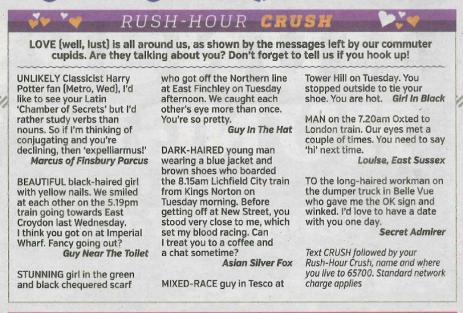
rush hour pic

So this is the second and last of the “bits of the paper we ignore” series. This one is based on my personal favourite, Rush Hour Crush. If you don’t know what this is, I suggest you check it out. Each morning on the way to work lovely people hand me a copy of the free newspaper, The Metro. It’s mostly awful (but actually very useful for the classroom as the articles are not that difficult or long) but  I do love the Rush Hour Crush section.

The idea is that commuters see people they fancy on the tube or a train or bus and they write a text to that person and send it to The Metro who prints it in the paper. It’s sooooo creepy and weird and hilarious and absolutely choc full of lovely vocab and noun phrases. Great fun for the classroom. So, if you don’t live in London, I shall bring London to you in all of its creepy glory. Enjoy!

Level: Intermediate and above

Time: 1.5 – 3 hours (depending on activities)

Objectives:

  • to encourage students to write more complex sentences, using noun phrases
  • to encourage students to notice the English around them and to ask questions of it

Materials:

  1. Rush hour crush
  2. Rush hour crush PDF
  3. rush hour crush text
  4. Rush hour crush answer sheet

Procedure:

This is reasonably straightforward but I’ll take you through it step by step:

  1. Gist reading: students skim the text for 30 seconds and discuss what it is and where it is from.
  2. Independent research skills: If possible, students Google and search for the text online to check their ideas.
  3. Engaging with the text: Students discuss the concept and share their initial impressions.
  4. Second reading: Students match the texts to the descriptions (see answer sheet)
  5. Vocab focus 1: students match the words/phrases from the text to the definitions given.
  6. Vocab focus 2: using the context and the vocab from the previous exercise, students try to decide what the phrases mean.
  7. Language focus:
  • students read the definition of a noun phrase (feel free to change this definition for one of your own).
  • students identify the noun phrases in the examples from the text (see answer sheet)
  • students examine them further and find specific types of noun phrase.
  • check as a group and discuss any issues
  • Students (in pairs) compete to write the longest complex sentence using noun phrases.

Follow-up

  1. What I would do (especially if you’re living in this country) is get students to write their own Rush Hour Crush texts and send them in. Even if you can’t send them in, get students to write them and make a poster. This is a lovely way to finish things off as it practises all of the target language and will lead to tonnes of new vocab and some lovely error correction before the texts are ready to be sent or put on a poster.


The bits of the paper we ignore 1!

This is to be part 1 of a 2 part series focusing on the bits of the newspaper we throw away. A lot of our lessons on this blog and the lessons we do in class use articles as the basis for the lesson. But what about the rest of the paper?

We want to encourage our students to be fully-functioning autonomous machines out in the real world, constantly analysing the English around them, learning new words and structures and reconfirming what they have learnt before. One way to do this is to help them find what they should be analysing in the first place.

This first lesson looks at an advertisement for a film. It’s a film I haven’t seen a to be honest I have absolutely no intention of seeing ever…but that doesn’t matter. Check out the lesson and let me know how it goes.

Level: Intermediate and above (although low-ints might need some help with some of the questions on the worksheet. A lot of ICQs and CCQs please!)

Time: 1 – 2 hours (depending on discussion times and follow-up activities)

Aim:

  1. to encourage sts to notice and analyse the language in the world around them.
  2. To gather vocab on dating

Materials:


full ad

Procedure:

This is quite a straight forward lesson. The worksheet takes you through it nice and easily. I think the only part that might need to be commented on is the final part, the reflection. The idea here it to get them thinking about the English that surrounds them. Even if you don’t live in an English speaking country, the Internet is at your disposal and by driving them to sites like IMDB.com, you can help them to see this.

Possible Follow-up Activities:

  1. students write their own tweets about bad dates (real or imaginary) and either put them up around the room for correction or tweet them using the hashtag at the bottom of the ad.
  2. Students look up new films in groups on IMDB and summarise them to their partners.
  3. Students set up a class online dating profile and send comments to people.