What do you consider when you’re planning a lesson? Would you ever not plan your warmer or your lead-in? Would you ever go into a lesson without planning your input stage? In this talk we urge teachers to plan in the forgotten stages, the ones that give students the time and space to assess and discuss how much they’ve learnt, and we offer a suggestion on how to balance a lesson so that there is an appropriate amount of time given to these stages.
If you’d like to learn more, you can find the slides below. If you’re interested in learning even more, check out the following blog posts or our delightful book, Overt Teaching.
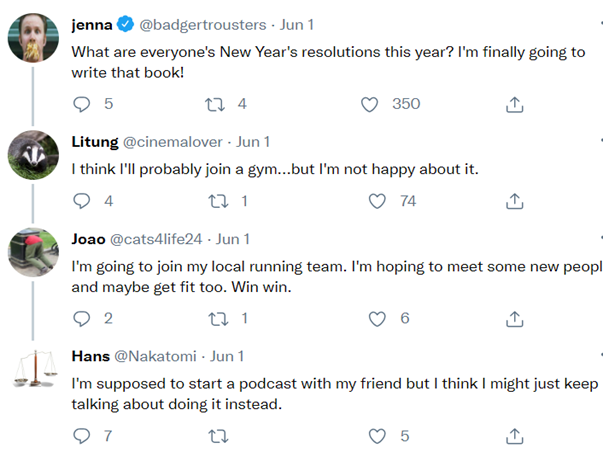
This lesson is obviously quite timely given the month but it very much focuses on analysing different future forms and highlighting how they are often used together. While the context is making resolutions on social media, the lesson goes on to show how these forms can be used in a range of different contexts.
Level: Pre-intermediate – Upper Intermediate.
Time: 90 minutes.
Objective: by the end of the lesson, learners will be better able to discuss their hopes and plans for the future.
Vocabulary focus: collocations for activities / hobbies.
Grammar focus: be going to / will / might / be supposed to.
Mark and I write and speak a lot about Overt Teaching. If you’d like to know more about what that is, you can read our blog post here or check out our handy dandy book, available on all good book websites and probably in the dark corner of a bookshop where they keep the rest of the EFL methodology books.
The core of Overt Teaching is that we believe we should be involving our learners in the discussion of learning throughout our lessons. We should be discussing the objectives of our lesson and helping learners to relate it to their lives and goals; we should discuss why we do what we do with our students, what our aims for a task are; we should give students the tools they need to reflect on their own success and give their peers feedback. And why? Because a more aware and invested student will be more engaged and make more progress.
In general when we talk about this at conferences or just one to one, our points and ideas are met positively. We’ve met very few teachers who really believe that it is a bad course of action or who do not want learners engaged with the learning process. However, we do often encounter some push back and it tends to be in the form of:
This is great but my students couldn’t do this.
There tend to be a number of reasons why teachers believe that their students would not be able to discuss learning but below are some of the most common, and a summary of some of the discussions we’ve had.
This is fine with higher levels but my students are too low. They don’t have the language you need to reflect.
Of all the levels, learning is most tangible at the lower levels. It can sometimes be as simple as “at the beginning of the lesson, you couldn’t talk about the past, now you can”. Very often reflection is viewed as a complex abstract topic that must be delved into in great detail. However, at beginner, elementary or pre-int, reflection at the end of a lesson can be a simple discussion:
What vocabulary did you learn today?
What grammar did you learn today?
How will you use it outside class?
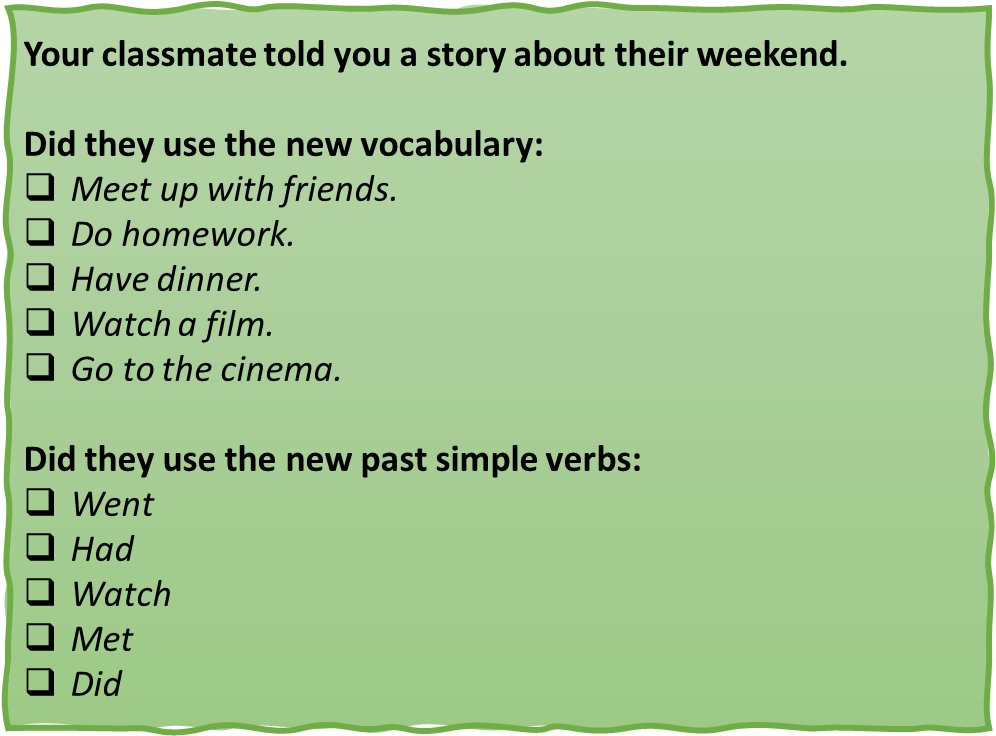
Success for a task can be laid out as using a specific piece of grammar or a number of items of lexis. Students can easily give peer feedback with short tick-boxes. The below can be easily used so students can choose their own lexis and their own level of success. It can be used as a peer-assessment or adapted for self-assessment.
This is fine with lower levels but my students are advanced and it is harder for them to see progress and reflect.
100% agree with the core of this statement. At higher levels it is more difficult for students to see their progress as it’s much less tangible. This, however, makes it even more crucial that learners are given the opportunity to reflect on and discuss what they’ve learnt. Without these discussions, students may come to the conclusion that they are not progressing because it is less tangible and visual.
At higher levels, students can converse easily on a range of topics. They can draw on their known, safe language and complete communicate tasks with relative ease. It is important therefore that we give them the opportunity before the task to make decisions about new language and skills they want to attempt, encouraging them to move outside their comfort zones. And then to reflect on how successful they were and what they want to try next time.
This is fine with adults but my students are too young to reflect and discuss their learning.
Most of my experience has been with older students, and while I have taught younger students, it is a number of years ago now. However, recently I got the chance to sit in on my 5-year-old son’s lesson. He was writing some words about a picture they had drawn. They were learning to write words to describe body parts. The teacher modelled it and then checked success criteria:
Where do we write? Chorus: under the picture.
How many words do we write on each line? Chorus: one.
Which words are we writing? Chorus: body word.
Students went off and wrote their words. Afterwards the teacher asked them to give their partners feedback using thumbs up or down while she moved around. She called out the success criteria again and students gave their partners thumb-based peer feedback.
Like anything, we grade the task. It’s all possible but needs to be scaffolded for the age or level. Here’s a nice idea for teaching writing using images of cupcakes the visualise layers of success.
This is fine but my students are from an educational background where they expect the teacher to give input the whole time. They’re not able to reflect.
There are so many things that we take for granted in an English language lesson that are not standard in every educational background. Depending on your age or culture, working with a partner may not be something you expect in class, but we do it because we know the value. For many students, being taught lexically might jar with their expectations but many teachers will persevere, confident that this is the best way for their students to learn.
Like anything, given the support and scaffolding, students will learn what is expected of them in class. Patience and understanding will often be necessary but if you feel that the discussion of learning is worthwhile and beneficial for them, then it’s worth spending the time helping your learners to develop those skills.
This is fine by my students want to focus on grammar and vocabulary input. There is not time for reflection and discussing learning.
As above really. If you value it, then it’s worth spending the time on it. The expectation of many students is that their lessons should be full of input so they can fill their notebook with notes which they may never look at again. What’s more important than every student knowing how much they’ve progressed in a lesson and knowing what they need to work on. Without discussing learning, this won’t happen. We’ve got to value these discussions and make the space in the lesson.
This is fine but I tried to do reflection tasks and my students couldn’t do it.
Giving peer feedback, reflecting on success or discussing your progress are not easy skills. However, they are skills that will help our learners in language learning but also in their lives beyond the classroom. They are valuable skills. The first time you try it with your students, they may struggle or balk as reflecting on input isn’t as easy as receiving and recording input for many. My advice would be:
Scaffold it carefully.
Do it little and often.
Don’t be put off if it’s tricky the first time. Persevere…it’s worth it.
This is fine but there are 50 students in my class so I can’t do this with them all.
The bigger your group, the more crucial it is that your learners are developing the skills they need to self-assess, peer-assess, reflect, and give feedback. With a large group, there is no way that a teacher can be expected to give meaningful feedback to everyone or assess their progress. The best we can do is develop the skills above and help our students to become more autonomous.
Let’s bring it all back home.
It’s not that we disagree with any of the above challenges. They are all challenges. However, if we believe in the value of these discussions and so we urge you to persevere and make it possible for your learners. They can all do it…they might just need your support.
I’m always interested in not just the language we use to communicate but the cultural ideas behind them. I remember the day that I learnt I had an understood sphere of acceptable personal space when I was communicating with others. I had just moved to Spain and was teaching 7-year-olds. Parent-Teacher meeting day came around and my Spanish was terrible. I had only been learning for 3 months. I worked hard and prepared my reports in Spanish with the help of my colleagues. I learnt them all off by heart and prayed that nobody asked any follow-up questions. One of my students, an amazing girl by the name of Lucia, was doing great in my classes but not so well in her English classes in her primary school. Understandably, but unfortunately for me, her mother had lots of questions.
She came in and caught me at the end of the meeting. I was standing in the corridor and she walked up stopping at a point that she felt comfortable and we began to have a conversation in my very broken Spanish about her daughter. My unconscious understanding of personal space kicked in and I took a step back. She then took a step forward and I took another back. By the end of the conversation when our odd dance had ended, I was 5 classrooms down the corridor with no idea how I’d gotten there.
From that point onward, I’ve been fascinated by all of the personal and cultural aspects of communication. It’s the little things that we assume is the same for everyone. But unless we discuss it, we often remain unaware that what is understood for one person or culture, can be offensive or shocking for another person. For that reason, I always had regular conversations with my students about how people communicate in their cultures. I never saw it as our job to teach this as such. More to facilitate that conversation so that our students can learn from each other and learn to communicative effectively with people from around the world.
This lesson focuses on greeting and encourages students to reflect on how they greet in their culture and to learn what others expect from a greeting. It’s designed for lower levels (elementary / Pre-intermediate) but as it’s an awareness raising lesson, it could be carried out with higher levels.
Intercultural Communication: Greeting
Level: Elementary / Pre-int (& above)
Time: 90 minutes
Objective: to raise awareness of how people greet in different cultures so that we can greet and have short conversations with people from around the world.
Over the past few months, I’ve been speaking to a lot of teachers about the emergence of AI and its impact on our industry. Reactions have ranged from fear to acceptance to excitement. It’s a really interesting time to be a teacher. I have to say, I understand the fear. For the majority, it’s not about machines rising against us or homicidal interactive whiteboards. For many it’s a fear of the unknown, we just got used to teaching online and now there’s another new piece of software we need to get to grips with, another tool that our students will be more familiar with than us. And that is very understandable.
In answer to that fear, I would say just try it out. Start small and take it from there. You don’t need to be the expert. It’s all about the first step. In this post, we’ll look at making that first step as easy as possible.
What problem can AI help to solve?
An easy first step is finding something you do regularly and explore how AI can help you achieve that more effectively. As a teacher, I remember spending hours scouring the internet looking for the perfect texts to use in my lessons, the perfect dialogue, story, article, etc. I’d come across one and it would be almost perfect but not quite. If you’ve ever had this issue, Artificial Intelligence is going to become your best friend.
For the purposes of this blog, we’re going to use Chat GPT. It’s free, easy to sign up to and easy to use.
What is the objective of your lesson? What kind of text would help you to achieve that objective? Is it a short story, an article, an anecdote, a poem, a dialogue, a text conversation? Whatever it is, Chat GPT will help you to write it.
Step 3: Get your prompt right
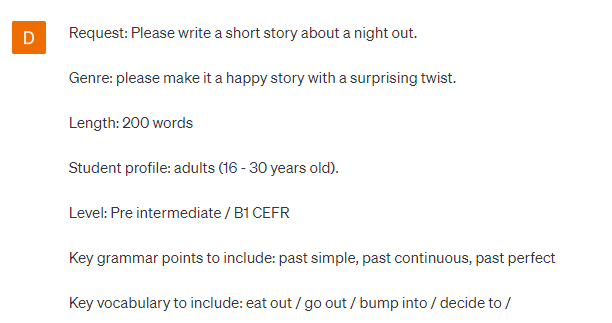
The key to getting the text you want is feeding Chat GPT the information it needs. For example, if you say “write me a story about a night out”, you might get a story that’s 1000s of words long or you might get a very short one. It might be a love story, a horror story, or a combination of both. You’re at the whim of Chat GPT. It’s all about the prompt. To ensure success, include:
Request:
Genre:
Length:
Student profile:
Level:
Key grammar points to include:
Key vocabulary to include:
Step 4: Edit your text
The beauty of Chat GPT is that if you don’t like your text, you can just click “Regenerate” and you’ll immediately get another version. You can also ask Chat GPT to refine your text by feeding it further prompts. For example, you could say: “please make this story shorter” or “please make the vocabulary a little simpler” or even “please rewrite this story in the first person”.
In my experience, you’ll probably still need to edit the story slightly to make it perfect for your specific group of students, but Chat GPT will do most of the heavy lifting for you and will do it in seconds.
Let’s look at an example:
I want to teach a lesson on telling stories using a range of narrative tenses. My topic is nights out. I asked Chat GPT to create a text for me. Using the prompt structure above, I fed it the information it would need.
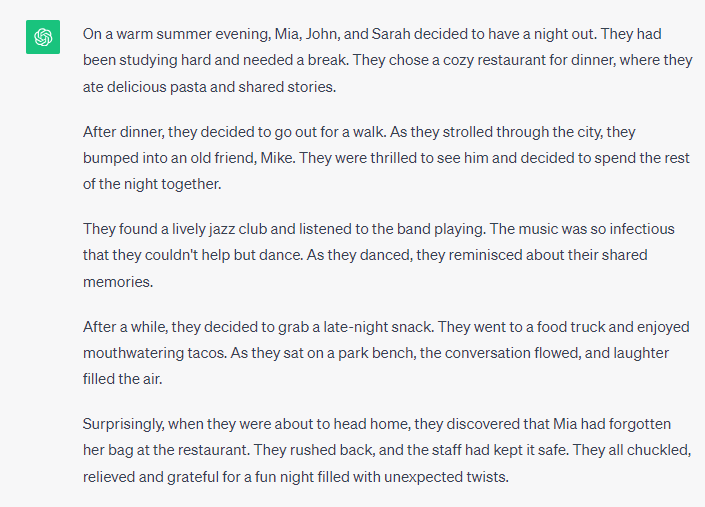
Chat GPT created the story below, which is a pretty good start but I felt there was some vocabulary that wasn’t really appropriate for this level.
I asked Chat GPT to replace the vocabulary with simpler vocabulary and got the following. This was pretty good but I wanted my students to tell their stories from the first person to better mirror how they tell stories in their real lives.
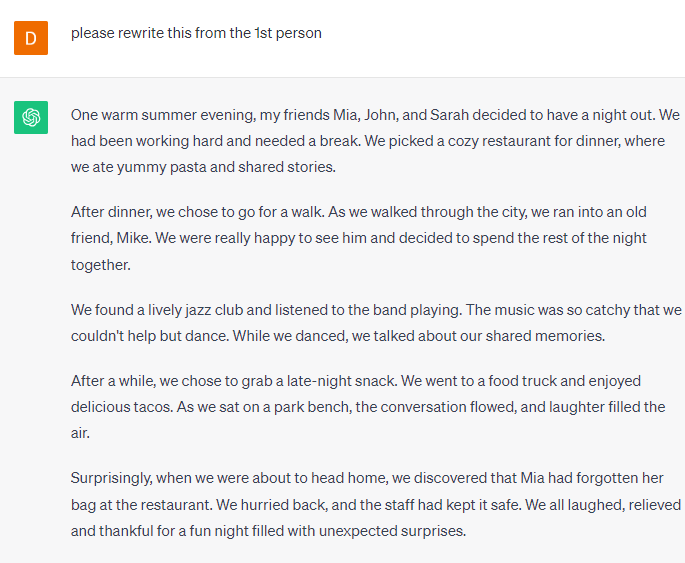
I asked Chat GPT to rewrite it from the 1st person point of view and thankfully it obliged.
I’ve now got a pretty decent text, at the level I want, in the format I want and the beauty of this is that it took about 2 minutes from start to finish.
A Final Thought:
AI isn’t perfect in any shape or form but it can save you a lot of time when it comes to lesson planning and materials creation, even if it’s just to give you some inspiration. So, before you go scouring the internet for the perfect text, why not take that first step and give AI a go. It’s not as scary as it might seem.
I absolutely love talking about food in class. I love how different cultures describe food, I love how literal some can be and how persuasive and descriptive others are. I love how totally convinced someone can be that the food from their country/culture is superior to another’s. I love the debates that ensue and all the language that emerges as a result. I love how curious everyone is off each other’s food customs. Food can be the gateway to lessons on question formation, circumlocution, descriptive language, instruction giving, debating and in the case of this lesson, writing skills.
This lesson focuses on describing food tastes and while the context is a food blog, the language (describing food and tastes) and the writing skill (organising a paragraph) are easily relatable to a range of speaking and writing contexts.
Details:
Level: Pre-Intermediate / Intermediate
Objective: by the end of the lesson, learners will be able to describe food tastes & write a paragraph that is easy for a reader to follow (e.g. in a blog post about food).
I wrote this lesson for a very simple reason. My friend sent me a photo of how his father-in-law drinks his coffee every morning and I just couldn’t get over it.
Every morning…every morning he drinks over a pint of incredibly milky coffee. I had so many questions and I kept thinking, I bet students would have lots of questions too. This is the lesson that followed.
Level: Elementary
Time: 90mins
Objective: Telling a story (e.g. about something you saw/did)
To make this lesson, I had to make a fake Instagram post and I came across my new favourite website. Great for making materials.
There is one movie trope above all others that really bugs me. You’ll see it occur in almost ever film set in a school. The students are in class, the teacher is explaining some crucial aspect of the lesson, the students are all slumped over their desks or tapping their pens, and then it happens…right in the middle of the teacher’s key input stage the bell goes off and just like that the lesson is over. The students pile out of class while the teacher shouts something along the lines of, “Read pages 40 to 400 and we’ll pick this up tomorrow!”
Then my poor wife has to pause the film and listen to me rant for the next ten minutes:
“But, but, they knew the bell was coming! The lesson is presumably the same length every day. It wasn’t a surprise. Why are they so bad at planning that they are surprised by the bell every day?! What happened in the first half of the lesson that caused them to be so off on their timings that they’re only getting to the main input stage in the final moments of the lesson! HOW IS ANYONE MEANT TO LEARN ANYTHING IN THESE LESSONS?!”
Then we carry on with the film and I silently seethe. Sometimes I ponder one question from my rant: what happened in the first half of the lesson? And sometimes I reflect on my own teaching and realise that while I was maybe never as bad as this movie trope, I was often guilty of front-loading my lessons to the detriment of my lesson objective.
Especially in my early years of teaching, I had a fear. A fear that informed how I planned and taught my lessons. It was a simple fear but if I’m honest, it had a serious impact on my students’ learning. What was it? It was the fear of running out of material before the end of my lesson. This fear of dead lesson time causes me to front-load.
What do I mean by “front-loading”?
If we imagine the average English language lesson will include the following major stages:
Schemata activation discussion.
A reading or listening text.
Comprehension checking questions.
Vocabulary input and practice.
Grammar or skill input.
Controlled practice of the grammar.
Freer practice of the grammar.
Feedback.
Front-loading occurs when a teacher spends the majority of their lesson time on stages 1 to 4, often supplementing with extra readings, listenings, or activities that relate to the topic. While these stages are important, it could be argued that they are the set-up for the input, practice, and feedback stages in which the real learning of the lesson occurs and learners will see real progress. This is not to say that the first stages are unimportant in any way, that set-up and schemata activation is hugely important but when front-loading occurs, it tips the balance of importance in favour of the set-up.
Where does “front-loading” come from?
Much like my early years of teaching, it is born from a fear that we will be left with empty lesson time and nothing to fill it. It comes from the belief that the material we have is not enough for the time we have. In my case this fear and belief persisted despite constant evidence to the contrary, despite always having to squeeze the most important stages of the lesson into the time left over.
How can we avoid “front-loading”?
Simple: plan less, teach more. When I am planning a lesson, I have to force myself not to front-load, not to spend too long on that opening discussion just because it’s interesting. The discussion is not my objective. The second half of the lesson is where the real learning occurs The first half is the set-up for the learning, it is just the context.
Below are some tips I employ to avoid front-loading:
Tip 1: I try to avoid supplementing with topic-based material. My learners might need more input or practice on the target language or skill but they probably don’t need another reading on the topic or another topic-based vocabulary exercise on top of what is already there. Any necessary lexis can emerge throughout the lesson.
Tip 2: Comprehension checking tasks aren’t always crucial to achieving my learning objective. If my objective isn’t to improve reading or listening comprehension, then maybe my lesson time is better spent on practice and feedback. I will often instead focus on the language within the text that will help my learners achieve their objective.
Tip 3: I remind myself constantly that it is ok to have time left over at the end of the lesson because:
Giving students the chance to repeat an activity and improve based on the feedback I’ve given, is an excellent use of class time.
Reflecting on what has been learnt in the lesson is worthwhile and my learners will benefit from this discussion.
Giving students time to consider how they will use the language they’ve learnt outside the classroom can help bridge the gap between the lesson and the real world, which is something I am constantly trying to achieve.
So, if you find yourself spending two thirds of your lesson on the set-up and squashing the actual learning into the final third, then avoid becoming a film trope and plan less, teach more.
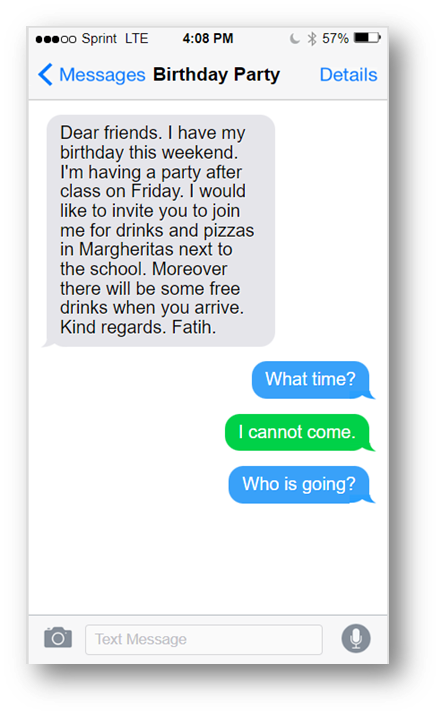
These days whether at work or in our personal lives, so much communication happens via social media messaging or texting apps. I can’t imagine my life without the ability to set up segmented groups of friends to organise events, work on projects or chat about inane interests.
We are big fans of using text messages for lessons for this reason but also because it is this beautiful hybrid of written and spoken English. More so than that, it is written spoken-English, which means you can easily teach or practise many speaking skills and conversation layouts in this more controlled medium of messaging.
Bringing text messaging into the classroom has many advantages. You can practise conversations at a slightly slower pace; it gives you more to feed back on as at the end of a text conversation, you can see everything that has been written, a luxury we aren’t afforded when monitoring a speaking activity; but above all, it mirrors real-life communication.
In this lesson we look at a common conversation of someone inviting a group of friends to a birthday event.
I was in a school recently chatting to a teacher and I keep going over something they said. I can’t get it out of my head so I thought I would write a cheeky blog and see if I could pick it apart.
I don’t give writing homework because then I just have loads of writing to mark.
I think we’ve all expressed similar sentiments over the years. After all, when you factor in planning time and post-lesson reflections, and CPD, and admin, a large pile of writing submissions doesn’t seem super appealing. And, while I was obviously frustrated that this issue was stopping students from getting writing practice and feedback (more on this later), it wasn’t this sentiment that stuck in my mind. It was the word “mark”.
Below are the questions, I would like to consider in this post. In the discussion that follows, I am considering General English classes as opposed to specific writing courses, EAP, or Exam Skills classes.
What do we actually mean by “mark” when it comes to a piece of writing?
Should we be marking our students’ writing?
What feedback should we be giving them to encourage development?
Can we somehow save ourselves from doing all the work?
What do we mean by “mark”?
I think what the teacher and our industry in general means by marking a piece of writing is one of two things.
Highlighting and correcting the student’s errors.
Indicating errors and the type of errors and encouraging the student to correct them, or rewrite it without errors.
When I was a slightly younger man, I was learning Spanish, and I was a proper beginner. Outside of “hola” and “una copa de vino por favor”, I was pretty useless. I decided to start by learning some key verbs I might want to use, and seeing as how I liked writing I chose to write a story. It was not a good story by any stretch of the imagination but man, I was proud of it. “Andy y los Animales” it was called. A single paragraph about Andy and the myriad animals he had, allowing me to use a range of verbs and a lexical set of animals I’d just learnt.
Like any good student, I wanted some feedback so I gave it to my then girlfriend to mark. Well, Jesus, I have never been so demotivated in my life. I got a back a paragraph covered in green (she’d been kind enough not to use red) underlines and corrections. Some errors she’d left for me to correct. What did I do? I thanked her, popped it in the back of my notebook, never looked at it again, and went off to eat jamon and queso in an attempt to quash the feelings of demotivation I had. To this day I haven’t written another story in Spanish. Sad but true.
What did I want in that moment? I’m not entirely sure but I think I wanted some positivity and something manageable that I could improve upon.
If you take the marking approach to writing feedback, take a minute to reflect on these questions:
Have you ever received similar feedback to the story above? How did you feel? What action did you take? Was it developmental?
When you mark your students’ work, do they take it on board? Do they submit corrections or rewrites?
Should we be marking our students’ writing?
I think it is clear from the story above, where my feelings lie but I want to think about this from another side. When we correct our students’ errors, are we actually marking or are we editing? I would argue the latter. Editing is a specific skill and something that people pay for. What do our students pay us for? It’s not an editing service. I would say they pay us to help them develop their English language, and learning skills. When we mark or edit, do we achieve this? I would argue no.
What kind of feedback do students want?
Well, that depends on the task itself. Before any feedback is given, everyone in the class (including the teacher) needs to be clear on the point of the exercise.
Writing for Fluency
If the aim is to encourage a love for writing, or merely to encourage students to write more, then feedback should reflect that. One example of this would be asking students to write a message and then replying to that message naturally without highlighting errors. Development can come later by identifying common writing skills or linguistic issues and dealing with them in class at a later point.
Writing as a vehicle for language
Very often writing is used as a vehicle to test language that has been learnt in a lesson or over a number of lessons. Feedback in this situation only needs to focus on the language that has been learnt and should not on other areas of writing or language that arise. Again, these can be focused on in later lessons. As this is all learnt language, there should be no need for a teacher to correct the language. There is an expectation from learners that they are being assessed on their use of specific language and that they will have to correct it. The content is more or less meaningless as long as the language is used correctly.
Practising a specific writing skill
If a specific skill has been developed in class, then obviously writing practice is the way to asses it. Maybe the teacher has taught their students about referencing, avoiding repetition, organising a text, writing a cohesive text, writing an effective paragraph, or any other writing skill. In this situation, the feedback can focus entirely on how successful the student has been with this skill.
Can we save ourselves some work?
I still understand the teacher who doesn’t want to set writing. They were starting from the point of view that their job is to edit their students’ work, or facilitate an edit by highlighting all the errors. However, as seen above, if the aim is to engage students and see development in a specific area, then feedback can be focused and doesn’t have to be extensive.
That said, even when it’s focused, feedback still takes thought and time. And, it is flawed as the responsibility is still on the teacher to identify any issues. Don’t we want our learners to be identifying their own issues and dealing with them before the piece of writing gets to the teacher?
Creating an extra line of feedback.
As mentioned above, the key to setting up a writing task effectively is that everyone knows what is expected of them in the task and what feedback they will receive. In the examples given above, a single area of language or a single skill are being practised/assessed. However, very often teachers will want to practise a number of different skills and language points at once, in a single cohesive piece of writing.
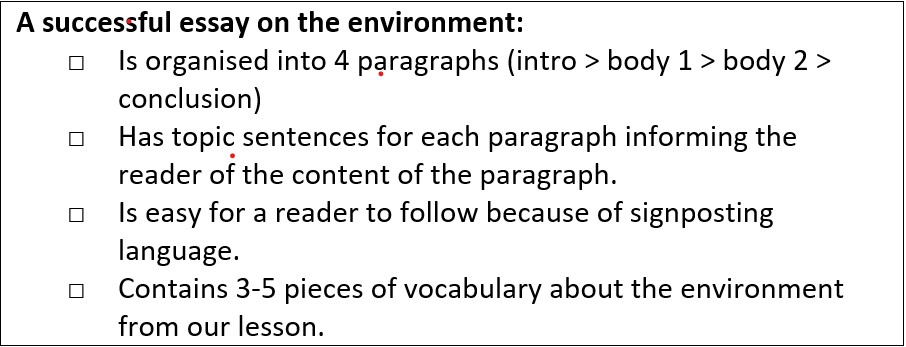
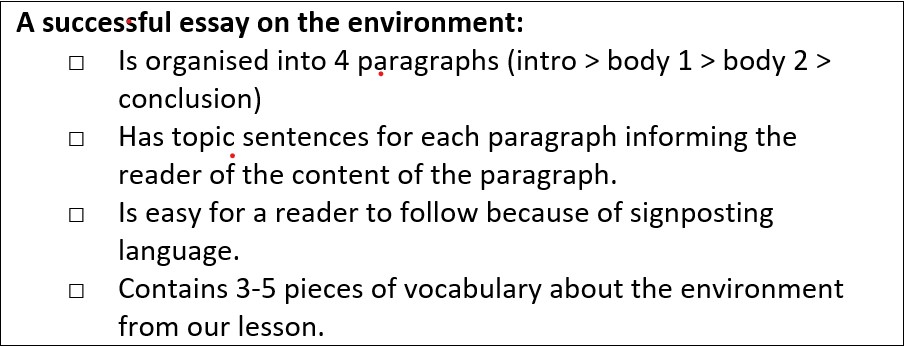
The fact remains, clarity of expectations is key. Clear success criteria enable students to assess their own writing and that of their partner’s before it reaches the teacher. Imagine a class in which students have learnt to write an essay on the environment. They have learnt to organise an essay, to write topic sentences for each paragraph, and to use sign-posting so that it is easy to follow. They have also learnt a range of lexical chunks related to the environment. In this class, the teacher provides their learners with the success criteria below:
Because of the clarity of the criteria, students can assess their work and their partner’s, giving each other feedback and upgrading their writing before handing it in. This can happen inside class time, making it even more likely that rewrites and edits will occur…and it saves a bit of time outside, which is always nice.
Conclusion
Sometimes we all get wrapped up in this is what we do and this is what it’s called. I think it is important that we challenge these norms and if they don’t hold up, then it’s time to put them in the bin. Is there a place for marking? Probably, but I’m not sure it’s a General English classroom. We’re teachers, not editors.



 textploitation