For Shame Ryanair: Error Correction

This is not so much a lesson as an idea for using what is around us as the beginning or end of a lesson. Done little and often, it could really make a difference.

As an English teacher you’ve probably had that moment when you read your friend’s Facebook messages and despaired at their shocking inability to use “their”, “there” and “they’re”…and these are native English speakers.

The fact is none of us are perfect and I only found out the other day that little things got my “hackles up” and not my “heckles up” like I’d thought for years…that was embarrassing.

Mistakes are all around us and one way of encouraging your students to correct errors in their work and that of others is to highlight this fact whenever possible. One option is to bring in Facebook comments or the comments from online newspapers.These are often chock-full of interesting little mistakes. Personally, I like to take pictures of any signs I find with errors on them. Sadly, in London these are everywhere. This one I actually found whilst flying over the Irish Sea on a Ryanair plane.

Ryanair needs to think long and hard about their use of hyphens. Check these pictures out and ask your students what the difference between “on-board” and “on board” is.


 For more on the errors all around us, check out this lesson on Nando’s.

I was in the same restaurant the other day and noticed yet another legend on the wall, once again riddled with missing words and spelling mistakes…come on, Nando’s, have a word with yourself.

Low-level Past Simple Story Lesson

THE WAKE-UP CALL

I’ve been working out of New English File Elementary recently and it’s a great book but as often is the case with a book, it never really 100% gets the challenge right for your particular group. Sometimes it’s too easy, sometimes it’s too hard. At the moment it’s a smidgen too easy for my group and we are absolutely motoring through it.

This lesson was basically a bit of an extension after we’d studied the Past Simple in the coursebook. It’s got some revision and it pushes a bit extra as well. We’ve also been talking a lot about language chunks / collocations / pieces of language / items of lexis (whatever you want to call them) so it looks at that a bit too.

Plus, it gets them using their imagination a little bit too, which never hurts…unless they say, “teacher I don’t have an imagination” and then we despair, oh yes we do.

  • Level: Elem / Pre-int
  • Time: 3 hours
  • Procedure: see below

Materials:

  1. Wake-up call (word worksheet)
  2. Wake-up call pdf (PDF worksheet)
  3. Wake-up call procedure
  4. Wake-up call – teacher’s copy


TIP: So, I’ve been teaching a lot of low level classes at the moment and they’ve been mostly smaller groups (2 – 4 students). One thing I’ve found is that when the group is this small, any worksheet or coursebook you break out means utter silence as they disappear into its depths. Or, it’s awkward because they’re too aware of you.

One way I’ve found of avoiding this is writing my worksheets up on the board, more or less how I’d have them on the sheet.

the students go up and work on the board as a whole or in pairs on different sections and you monitor from behind them. It really makes a difference.

you can always give them the worksheet afterwards. Here’s a pic of my board for this lesson. You might notice there are some mistakes on the board. Their first task was to correct the errors and then later I gave them the worksheet with the corrected version to check it, which is a slight variation on the procedure above.

Here’s a shot of my board. I like to think that my distinctive cursive script adds an extra layer of challenge to the lesson and is, of course, completely intentionally awful

wake up call boardwork

My “Favourite Film” Lesson

OK Once is not actually my favourite film but it’s not bad at all. I was in the middle of a lesson the other day and this was the only film I could think of. I did this lesson (or a version of it) and it went really well.

It’s a simple low-level lesson and if you do similar lessons or activities little and often, you really will begin to get slightly more autonomous students. The whole idea is to encourage them to notice the language that’s all around them just a little bit more.

In this case, they have a tiny text but they’re going to use it to notice 3 language points as well as working on noticing errors and getting the meaning of vocab from context.

  • Level: elementary / pre-intermediate
  • Time: 1 – 3 hours
  • Objective: to encourage sts to notice language in context

Materials:

  1. favourite film worksheet
  2. Procedure


If you’re looking for some more film related lessons try this one or this one

Tip: If a film comes up in class that your students don’t know, do a research hunt. Give them 3 minutes and send half the class to IMDB and half to Wikipedia and then see what they come up with. It’s great for practising independent research skills.

Grammary Songs! The Script

I’m sorry…I may have gone too far this time and I completely understand if you want to turn your back on me and leave me to wither away into nothingness. I’ve made a lesson out of a Script song. In my defense, it’s not my fault. A student made me do it. This is what happens when you have Spanish teenage girls, who’ve spent a summer in Ireland as students. Honestly not my fault.scripts 1

Anyway, you may remember that I once wrote abouthaving a short extract from a song for every language point. The idea was that it was engaging for students, it gave them a bit of access to the culture and it (hopefully) made the language point a little more memorable.

My first lesson was on “used to” and “would” using a Coldplay song…again, sorry. Check it out if you want to see what I was on about.

This one shouldn’t be a long lesson but it’s a nice communicative one with some guided discovery in there.

Level: Int and above

Time: 1 – 2 hours (depending on how chatty your students are)

Aim: see above

Objective: see above

Materials:

  1. if you ever come back – worksheet
  2. if you ever come back – teacher’s answers


Procedure:

  1. Listening for gist / engagement: Play the full song and have students discuss the questions at the top of the worksheet. The idea here is that they engage with the song and love it, hate it or loathe it but at least they engage.
  2. Language focus (vocab): these are quite nice phrases and this activity will really encourage them to think about language in context instead of jumping to dictionaries. You can help them out with the individual parts of the expression (e.g. shoulder) if you think they need guidance.
  3. Language focus (wish): this is all quite self-explanatory guided discovery. The hope is that students can analyse the language in context and decide how it would be used. You might need to walk them through the first one if they struggle with this kind of thing.
  4. Practice: always good to practice.
  5. discussion: This will bring the whole thing together and give them a chance to discuss the topic and use the target language.

The bits of the paper we ignore 2

rush hour pic

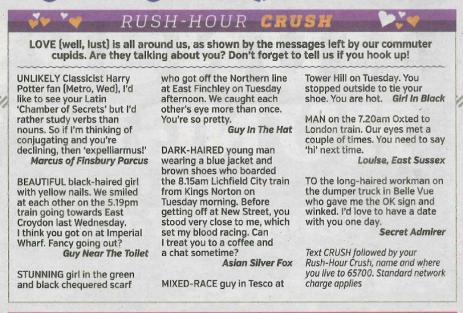
So this is the second and last of the “bits of the paper we ignore” series. This one is based on my personal favourite, Rush Hour Crush. If you don’t know what this is, I suggest you check it out. Each morning on the way to work lovely people hand me a copy of the free newspaper, The Metro. It’s mostly awful (but actually very useful for the classroom as the articles are not that difficult or long) but  I do love the Rush Hour Crush section.

The idea is that commuters see people they fancy on the tube or a train or bus and they write a text to that person and send it to The Metro who prints it in the paper. It’s sooooo creepy and weird and hilarious and absolutely choc full of lovely vocab and noun phrases. Great fun for the classroom. So, if you don’t live in London, I shall bring London to you in all of its creepy glory. Enjoy!

Level: Intermediate and above

Time: 1.5 – 3 hours (depending on activities)

Objectives:

  • to encourage students to write more complex sentences, using noun phrases
  • to encourage students to notice the English around them and to ask questions of it

Materials:

  1. Rush hour crush
  2. Rush hour crush PDF
  3. rush hour crush text
  4. Rush hour crush answer sheet

Procedure:

This is reasonably straightforward but I’ll take you through it step by step:

  1. Gist reading: students skim the text for 30 seconds and discuss what it is and where it is from.
  2. Independent research skills: If possible, students Google and search for the text online to check their ideas.
  3. Engaging with the text: Students discuss the concept and share their initial impressions.
  4. Second reading: Students match the texts to the descriptions (see answer sheet)
  5. Vocab focus 1: students match the words/phrases from the text to the definitions given.
  6. Vocab focus 2: using the context and the vocab from the previous exercise, students try to decide what the phrases mean.
  7. Language focus:
  • students read the definition of a noun phrase (feel free to change this definition for one of your own).
  • students identify the noun phrases in the examples from the text (see answer sheet)
  • students examine them further and find specific types of noun phrase.
  • check as a group and discuss any issues
  • Students (in pairs) compete to write the longest complex sentence using noun phrases.

Follow-up

  1. What I would do (especially if you’re living in this country) is get students to write their own Rush Hour Crush texts and send them in. Even if you can’t send them in, get students to write them and make a poster. This is a lovely way to finish things off as it practises all of the target language and will lead to tonnes of new vocab and some lovely error correction before the texts are ready to be sent or put on a poster.


The bits of the paper we ignore 1!

This is to be part 1 of a 2 part series focusing on the bits of the newspaper we throw away. A lot of our lessons on this blog and the lessons we do in class use articles as the basis for the lesson. But what about the rest of the paper?

We want to encourage our students to be fully-functioning autonomous machines out in the real world, constantly analysing the English around them, learning new words and structures and reconfirming what they have learnt before. One way to do this is to help them find what they should be analysing in the first place.

This first lesson looks at an advertisement for a film. It’s a film I haven’t seen a to be honest I have absolutely no intention of seeing ever…but that doesn’t matter. Check out the lesson and let me know how it goes.

Level: Intermediate and above (although low-ints might need some help with some of the questions on the worksheet. A lot of ICQs and CCQs please!)

Time: 1 – 2 hours (depending on discussion times and follow-up activities)

Aim:

  1. to encourage sts to notice and analyse the language in the world around them.
  2. To gather vocab on dating

Materials:


full ad

Procedure:

This is quite a straight forward lesson. The worksheet takes you through it nice and easily. I think the only part that might need to be commented on is the final part, the reflection. The idea here it to get them thinking about the English that surrounds them. Even if you don’t live in an English speaking country, the Internet is at your disposal and by driving them to sites like IMDB.com, you can help them to see this.

Possible Follow-up Activities:

  1. students write their own tweets about bad dates (real or imaginary) and either put them up around the room for correction or tweet them using the hashtag at the bottom of the ad.
  2. Students look up new films in groups on IMDB and summarise them to their partners.
  3. Students set up a class online dating profile and send comments to people.

For shame, Nandos! Editing texts


So there I am, sitting in Nandos in Gatwick airport, killing time with chicken, when I glance to my left and see a large text painted on the wall. As all EFL teachers know, there are two aspects of the job that we just can’t turn off:

  1. Constantly looking out for new material for our lessons.
  2. The mistake alarm. Every time we see or hear one it rings loud and clear.

The second of these has made Facebook and Twitter hard to bear for much of us, especially with friends writing things like “You should of called me”…GAHHHHHH!!!!!!!!

Sadly Nandos is no different and this little text had three separate mistake clangers in there. However, it also had some negative inversion and some nice vocab in there so I decided to take a photo (I then had to put up with weird looks from around the room) and use it in a lesson.

I’ve yet to use it but here’s the material and the procedure. If you try it before me, let me know how it goes.

Level: Upper intermediate + above (nice for Cambridge exam groups too)

Time: 90 mins – 3 hours

Material:

Objective:

  • The main aim here is to encourage our students to be more analytical, to notice the English all around them. This mean noticing mistakes as well as new vocab and interesting language patterns.


Procedure:

  1. Display the word “Legend” on the board and ask sts to discuss what it means. Then show them the dictionary definition and get them to check their ideas. (I like to use full dictionary definitions from time to time to encourage sts to use English – English dictionaries and to look at common features of dictionaries, especially how to understand the pronunciation)
  2. Get students to chat about the discussion questions and then feedback as a group. I’d try to get as much interesting language from their legends up on the boards now as it could help later.
  3. Students skim read the text (30 seconds) and in pairs retell it in their own words.
  4. Vocab focus: Sts match the key vocab from the text with the definitions/synonyms on the worksheet.
  5. Editing: Sts work together to find the mistakes. See the teacher’s copy for the answers.
  6. Language focus: Sts examine the negative inversion sentence and feedback as a class.

Follow-up:

  1. Ask sts to retell the story and record their stories. I think it would be interesting to compare the language they use to tell the story and the language of the text. The key vocab will be the same but the style of the text is very much that of a legend. I think this would be an interesting comparative analysis.
  2. Going back to the discussion at the beginning of the lesson, sts use the vocab boarded then and the legend style discussed above to write their own legends.
  3. Place them around the room and encourage sts to move around with two tasks. (1) find errors & (2) decide who has written the best legend in keeping with the style discussed above.

A might well:The many forms of “might”

A borderline advanced student stopped me in the corridor the other day and asked me what the difference was between might, might as well and might well and for a moment I was stumped. He was holding his Upper Int coursebook on the grammar reference section for “might” and he made a very good point which was:

The Upper Intermediate book has exactly the same information as the Intermediate.

He was right, so I decided to look at it in a little bit more detail and came up with the lesson below.

The materials and the teaching notes are all in the same file and I’ve attached it as a PDF and as a WORD doc so that you can edit it if you like.

Enjoy

  1. might-as-well  – WORD doc
  2. might-as-well  – PDF


guys pic


Could I ask your advice on something? Should / If I were you…

beaten up

This is a relatively straightforward test/teach/test type of lesson but there’s lots that you can do with it. I’ve put the basic lesson plan below and then a few suggestions for extra activities you could do.

The whole point of the lesson is to practise giving advice, largely using conditionals and should. It really encourages students to analyse language and hopefully to use it afterwards.

Level: Intermediate and above

Time: 2 – 3 hours

Materials:

  1. advice
  2. problems and pics
  3. advice (PDF)
  4. problems-and-pics (PDF)

Procedure:

(1)

Test:

As the first test, I like to walk in and tell my students a personal problem. I quite like pretending that it’s a real one and asking their real advice but that’s up to you, you could even say it’s your friend’s problem and your telling them about it. Here’s a problem I often start with:

So, my girlfriend rang me last night. Turns out she wants to move to Brazil. She says she can’t handle the weather here anymore and needs a change. I completely get it, going to Brazil would be amazing but we’ve got stable jobs here, things are going well, I’m really enjoying where I live right now…I just don’t know what to do.

We usually discuss it for a bit and then I say OK everyone, write down one piece of advice for me. (It’s a nice idea to give them a post-it note and then collect them in afterwards). you can come back to these pieces of advice later on.

(2)

Pre-Reading / Gist Reading

Display the picture of the 2 men on the board or hand them out and get sts to decide what they’re discussing.

Instruct sts to read through the dialogue and answer the questions on the top.

(3)

Language Focus: Advice structures

Get the students to read the dialogue again and underline any structures giving or asking for advice. They should find the obvious “should” and “if I were you” but also highlight the chunks of English “Do you mind if I ask your advice on something?”.

Very often students skim over language without really noticing what’s going on. The idea with this exercise if to get them in the habit of examining the structures they come across in the hopes they can reproduce them in the future.

The really interesting piece of language here is that the “If I were you” structure is used twice, once to give advice for future and once to comment on the past. Draw their attention to this and to the form as they’ll have the opportunity to practice it in a second.

(4)

Controlled Practice

Display one of the pictures and the problems from the set, whichever one you like.

In pairs, ask sts to write their reply to this person. Don’t give them too much in the way of guidelines here as this can produce some really interesting language. I like to give them a post-it note to do this on as then I can collect them in easily.

Correct any errors in advice that come up, board any other ways of giving advice that come up and any interesting language you find.

(5)

Freer Practice

Display the remaining problems and pictures around the room. Students walk around in pairs and give advice to the pictures.

Teacher monitors, helps out when necessary and notes down interesting errors and language.

Feedback as a whole class and correct anything that has arisen.

Star Wars – may the grammar be with you

So, Star Wars, love it or hate it, I am firmly in the former camp, it is going to be a big deal this winter.  So, what better way to engage students with a bit of grammar?

This is using quotes from the film, the whole tiny texts thing that we are into.  I’ve tried to use them for different grammar points and it should be seen as either revision, or perhaps an introduction for some of these grammar points.

I would say you should be thinking Upper Int upwards, though you could edit out sections, for example the section on negative adverbial inversion, and do it with Intermediates.  It really is a bit of a pick and mix, whichever parts you want.

Procedure:

Just follow the worksheet really.

However,  with the scrolling text you need to try to get them to take notes to check, or you could throw some simple questions up there for them.

  1. What type of base is it?
  2. What did rebels steal?
  3. Where is Leia going?

Materials:

  1. Star Wars – Word
  2. Star Wars – PDF Version
  3. star-wars-answers

PS – the reason for the PDF was that the fonts changed and it really annoyed me.