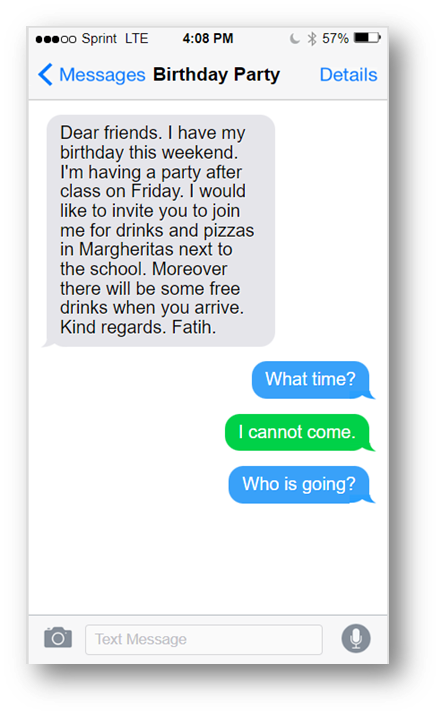
These days whether at work or in our personal lives, so much communication happens via social media messaging or texting apps. I can’t imagine my life without the ability to set up segmented groups of friends to organise events, work on projects or chat about inane interests.
We are big fans of using text messages for lessons for this reason but also because it is this beautiful hybrid of written and spoken English. More so than that, it is written spoken-English, which means you can easily teach or practise many speaking skills and conversation layouts in this more controlled medium of messaging.
Bringing text messaging into the classroom has many advantages. You can practise conversations at a slightly slower pace; it gives you more to feed back on as at the end of a text conversation, you can see everything that has been written, a luxury we aren’t afforded when monitoring a speaking activity; but above all, it mirrors real-life communication.
In this lesson we look at a common conversation of someone inviting a group of friends to a birthday event.
I was in a school recently chatting to a teacher and I keep going over something they said. I can’t get it out of my head so I thought I would write a cheeky blog and see if I could pick it apart.
I don’t give writing homework because then I just have loads of writing to mark.
I think we’ve all expressed similar sentiments over the years. After all, when you factor in planning time and post-lesson reflections, and CPD, and admin, a large pile of writing submissions doesn’t seem super appealing. And, while I was obviously frustrated that this issue was stopping students from getting writing practice and feedback (more on this later), it wasn’t this sentiment that stuck in my mind. It was the word “mark”.
Below are the questions, I would like to consider in this post. In the discussion that follows, I am considering General English classes as opposed to specific writing courses, EAP, or Exam Skills classes.
What do we actually mean by “mark” when it comes to a piece of writing?
Should we be marking our students’ writing?
What feedback should we be giving them to encourage development?
Can we somehow save ourselves from doing all the work?
What do we mean by “mark”?
I think what the teacher and our industry in general means by marking a piece of writing is one of two things.
Highlighting and correcting the student’s errors.
Indicating errors and the type of errors and encouraging the student to correct them, or rewrite it without errors.
When I was a slightly younger man, I was learning Spanish, and I was a proper beginner. Outside of “hola” and “una copa de vino por favor”, I was pretty useless. I decided to start by learning some key verbs I might want to use, and seeing as how I liked writing I chose to write a story. It was not a good story by any stretch of the imagination but man, I was proud of it. “Andy y los Animales” it was called. A single paragraph about Andy and the myriad animals he had, allowing me to use a range of verbs and a lexical set of animals I’d just learnt.
Like any good student, I wanted some feedback so I gave it to my then girlfriend to mark. Well, Jesus, I have never been so demotivated in my life. I got a back a paragraph covered in green (she’d been kind enough not to use red) underlines and corrections. Some errors she’d left for me to correct. What did I do? I thanked her, popped it in the back of my notebook, never looked at it again, and went off to eat jamon and queso in an attempt to quash the feelings of demotivation I had. To this day I haven’t written another story in Spanish. Sad but true.
What did I want in that moment? I’m not entirely sure but I think I wanted some positivity and something manageable that I could improve upon.
If you take the marking approach to writing feedback, take a minute to reflect on these questions:
Have you ever received similar feedback to the story above? How did you feel? What action did you take? Was it developmental?
When you mark your students’ work, do they take it on board? Do they submit corrections or rewrites?
Should we be marking our students’ writing?
I think it is clear from the story above, where my feelings lie but I want to think about this from another side. When we correct our students’ errors, are we actually marking or are we editing? I would argue the latter. Editing is a specific skill and something that people pay for. What do our students pay us for? It’s not an editing service. I would say they pay us to help them develop their English language, and learning skills. When we mark or edit, do we achieve this? I would argue no.
What kind of feedback do students want?
Well, that depends on the task itself. Before any feedback is given, everyone in the class (including the teacher) needs to be clear on the point of the exercise.
Writing for Fluency
If the aim is to encourage a love for writing, or merely to encourage students to write more, then feedback should reflect that. One example of this would be asking students to write a message and then replying to that message naturally without highlighting errors. Development can come later by identifying common writing skills or linguistic issues and dealing with them in class at a later point.
Writing as a vehicle for language
Very often writing is used as a vehicle to test language that has been learnt in a lesson or over a number of lessons. Feedback in this situation only needs to focus on the language that has been learnt and should not on other areas of writing or language that arise. Again, these can be focused on in later lessons. As this is all learnt language, there should be no need for a teacher to correct the language. There is an expectation from learners that they are being assessed on their use of specific language and that they will have to correct it. The content is more or less meaningless as long as the language is used correctly.
Practising a specific writing skill
If a specific skill has been developed in class, then obviously writing practice is the way to asses it. Maybe the teacher has taught their students about referencing, avoiding repetition, organising a text, writing a cohesive text, writing an effective paragraph, or any other writing skill. In this situation, the feedback can focus entirely on how successful the student has been with this skill.
Can we save ourselves some work?
I still understand the teacher who doesn’t want to set writing. They were starting from the point of view that their job is to edit their students’ work, or facilitate an edit by highlighting all the errors. However, as seen above, if the aim is to engage students and see development in a specific area, then feedback can be focused and doesn’t have to be extensive.
That said, even when it’s focused, feedback still takes thought and time. And, it is flawed as the responsibility is still on the teacher to identify any issues. Don’t we want our learners to be identifying their own issues and dealing with them before the piece of writing gets to the teacher?
Creating an extra line of feedback.
As mentioned above, the key to setting up a writing task effectively is that everyone knows what is expected of them in the task and what feedback they will receive. In the examples given above, a single area of language or a single skill are being practised/assessed. However, very often teachers will want to practise a number of different skills and language points at once, in a single cohesive piece of writing.
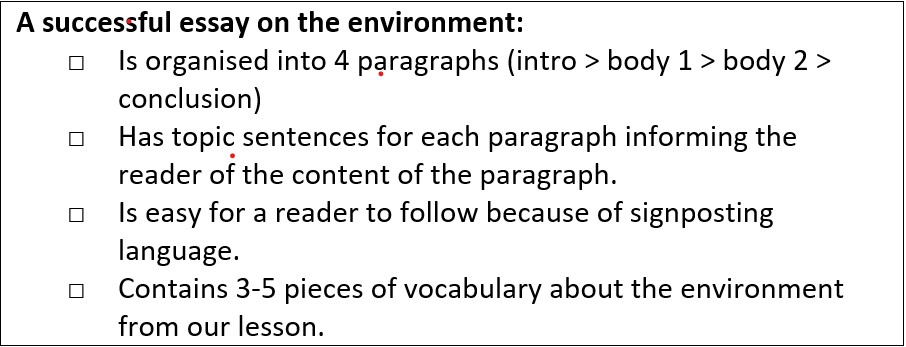
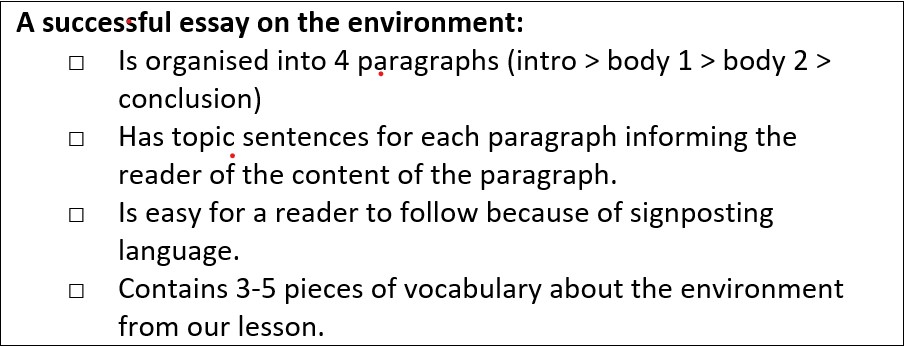
The fact remains, clarity of expectations is key. Clear success criteria enable students to assess their own writing and that of their partner’s before it reaches the teacher. Imagine a class in which students have learnt to write an essay on the environment. They have learnt to organise an essay, to write topic sentences for each paragraph, and to use sign-posting so that it is easy to follow. They have also learnt a range of lexical chunks related to the environment. In this class, the teacher provides their learners with the success criteria below:
Because of the clarity of the criteria, students can assess their work and their partner’s, giving each other feedback and upgrading their writing before handing it in. This can happen inside class time, making it even more likely that rewrites and edits will occur…and it saves a bit of time outside, which is always nice.
Conclusion
Sometimes we all get wrapped up in this is what we do and this is what it’s called. I think it is important that we challenge these norms and if they don’t hold up, then it’s time to put them in the bin. Is there a place for marking? Probably, but I’m not sure it’s a General English classroom. We’re teachers, not editors.
This is just going to be a short post on something that I encounter a lot as I teach my students a university. My students know linking words. They equate them with good writing. They use them frequently, but with little distinction in their meaning and actual function. This is hardly surprising, below is a list of linking words listed as “To transition to a different or even opposite idea.” on a popular website aimed at helping students achieve an 8 in writing in the IELTS exam.
Conversely, nevertheless, on the other hand, on the contrary, despite, in spite of, although, even though, but, yet, while, however, except, in comparison, by contrast, however.
From an IELTS and other exam classes perspective, this perhaps makes some sense. I can even bite my tongue at the fact they are grammatically different in many regards, because ultimately, in IELTS, the students are not predominantly marked on their stance and argument, but on the language they use to get there. Their answer is merely the boat which neatly carries their language to the assessor. So, what is the problem? Students need good IELTS scores and we should help them to prepare for that.
I agree to a point, but it doesn’t prepare students for what will come next. At university, we care far less about the language; our metaphor is reversed. Now, the language is the boat, and the answer is our precious cargo. This total reversal can cause issues for students. They move from writing generally about topics in lots of long words, to a preference for giving clear indication of their ideas and arguments in clear language. I may come onto building lexical chains through repetition in another blog, but for the moment, let’s focus on linkers or as I would prefer us to see them ‘signposts’.
A Question
What is the difference between the following two sentences?
A “Although many teachers believe that students expect teachers to teach in a top down deductive approach, others have argued for a more inductive approach.”
B “Many teachers believe that students expect teachers to teach in a top down deductive approach. However, others have argued for a more inductive approach.”
Which of these two examples implies that the writer might side with an opinion?
Or, to look at it a different way, which sentence is more likely to be followed by this sentence: “This would mean changing the way that materials are written and ensuring our students have the tools needed to be able to discuss their learning.”
I hope the answer you came to was B. When we use although and other concessional conjunctions at the beginning of sentences, we are often guiding the reader to our opinion. We are likely to give more weight to the second clause. However doesn’t work like that. It compares two equals. So, we have an issue with the list above. Students may be signposting their opinions without realising it, or worse, misleading readers with these terms.
Ways to address it in an ielts classroom
This is only going to be a short blog post, so I am not going to go into a lot of detail here. However, firstly, we can stop telling students these are all the same. Rather than looking at them as linkers, tell students that they ‘signpost’ the way for the reader. They help us map our way.
Secondly, when you see examples, ask simple questions like the one above.
Thirdly, bring in examples. I am a big fan of using authentic materials for things like this. If you wanted to show students some academic abstracts, this may be a useful site for them: http://collections.flax.nzdl.org/greenstone3/flax
I have an abstract below and a very short activity.
Short activity for with an abstract
Ask students to highlight any of the linking words / signposts they can see in the text. (Here, you can see however – though it is used more as an adverb than a true linking device. Despite here is used as Although was above. Equally and but are possibly the only true linkers here.)
Ask the students if this these words or more, or less frequent than they might have expected.
Ask them to identify how cohesion is being achieved. (Use of This / The + noun)
Ask students if they could swap However for Despite here and if they do so, how would the meaning change?
Any of these activities will help students along the journey of linker to signpost and hopefully better prepare them for after their exam and their future studies.
A force to be reckoned with? : the Temperance Movement and the “drink question”, 1895-1933
The Temperance Movement was one of the most important and influential of the great nineteenth century social and moral reforming campaigns, firmly integrated with the central Victorian values of self-help, hard work and sobriety. As the values of the Victorian period dissipated with the rapidly changing social and ethical mores during the twentieth century, most historians have seen a similar demise in the role of the Temperance Movement. The drink question, however, remained a significant issue with two Royal Commissions, unprecedented state intervention during the First World War and innumerable bills and legislative debate between 1895 and 1933. Equally, the Temperance Movement maintained its resolve, resolutely campaigning and lobbying, proving itself to still be a key factor in the drink debate. This thesis studies the role and activity of the Temperance Movement in the continuing national concern around drink between 1895 and the Peel Commission to the conclusion of the Amulree Commission in 1933. The thesis concentrates on the major temperance societies and examines their effect on English attitudes to the drink question. Despite its continued activity, the Temperance Movement failed to make a significant mark on policy toward drink during this period. The reasons for this are several – loss of political support, the changing nature of drink issues, and fragmentation in the Movement. The Temperance Movement was very heterogeneous, some organisations seeking moderate reform or moral suasion but the more radical campaigners demanded central or local prohibition. Such demands were the root cause of temperance division and a large factor in the loss of Liberal political support. With the Conservatives tied to the Trade, the Temperance Movement sought the assistance of the Labour Party but Labour’s response during the period was vague and indecisive. Social and moral arguments used by the Temperance Movement in its attempt to secure the abolition of the drink trade were being steadily eroded as secularism, post war cynicism and a huge increase in leisure activities undermined older values. Demand for alcoholic beverages fell dramatically as did reported cases of drunkenness. Despite these changes drink remained on the political and social agenda, but with many temperance reformers disillusioned and dispirited the Movement failed to present a comprehensive and coherent abolition strategy.
Recently I wrote this post on aims and objectives and as always with this topic, there will be those that agree and those that disagree. It really seems to polarise our industry in a way that it doesn’t seem to in K-12 teaching (or at least that I’ve come across). I thought it would be interesting to think about that and consider some of the common arguments against knowing and communicating what you want to achieve and it seems to me to boil down to one main issue. The belief that:
Having aims and objectives locks us in and an English language lesson should be free to go wherever the students need it to go.
Now, there are a lot of things I could pull from that. The two sides of the Great Objective Debate could spend hours arguing back and forth with neither giving any ground, like academic Brexiteers and Remainers. But where would that get any of us.
Instead, I mentioned it to my wife and she mentioned that in her industry (grant-giving/management in the charity sector) they always have clear objectives for a project but afterwards they like to sit down and carry out an activity called outcome mining in which they pull out and discuss all of the unintentional outcomes they achieved throughout the project. And as she said it, I wondered if maybe this was a bridge between the two camps.
I in no way believe that one should teach their aims/objectives blindly without thinking about the students in front of them or dealing with interesting language that comes up as a matter of course. I fully believe that the job of the teacher is to react and manage what happens in front of them, ensuring that what they’re teaching is relevant and accessible for the specific students in front of them. But I also believe they (and their students) should know from the beginning of the lesson what they are trying to achieve.
Maybe the perfect world is:
Knowing what you want to achieve
Communicating it to your students and discussing how you intend to achieve it
Being open to your students wanting to achieve it in a different way
Being open to unintended outcomes that arise throughout the lesson
Spending time at the end of the lesson reflecting on:
Let me start by saying I love Christmas. Absolute love it, can’t get enough of it. Keep that in mind when I say the following:
MY MOST HATED TIME OF THE WHOLE ENGLISH LANGUAGE TEACHING YEAR IS CHRISTMAS!
I can’t stand it. I have always hated teaching at this time of year largely because of my context:
Continuous enrollment: this means that half of the class have been in the school for months and are looking forward to some more relaxed lessons over Christmas as they wind down while the other half are only in the school for a few weeks and are keen to make every minute count.
Numerous teachers: most likely students studying for 3-4.5 hours every day will have a number of teachers and are likely to have several people trying to do Christmas lessons with them.
For these reasons I made the decision many years ago that no matter the holiday, I was going to teach the same as any other day of the year. Sure, I might use the holiday as a topic but no more than that. This means no questionable gapfills of Jingle Bells or scenes from Love Actually with tenuous objectives, and definitely no bringing in the Winter Wonderland song and trying to make sense of the madness that is “in the meadow we can build a snowman and then pretend he’s Parson Brown”. Who in the name of the wee man is Parson Brown?!
But I digress…
So yes, that’s right, I am saying that I am the EFL Christmas Grinch, stealing relaxed Christmas lessons from my students and colleagues.
But worry not, I am not completely without heart. As I said, I do embrace the holiday as a topic in my lessons so here are 2 for you if you decide to go down the EFL Christmas Grinch route.
I LOVE clear aims and objectives in a lesson. When I see a group of students and a teacher who know what they’re learning and why they’re learning it, I go all warm and fuzzy inside. But I hate useless admin, admin for the sake of it. I can’t stand the statement “we’ve always done it this way” it makes me the opposite of warm and fuzzy inside…chilly and smooth?
Recently I had a conversation with a teacher that made me go a bit chilly and smooth but I do not think this is an isolated occurrence. In fact I remember feeling this very way in my early years as a teacher. We were discussing aims and objectives and he said:
“I don’t know if anyone else feels this way but I always write my aims and objectives because I know I have to but I don’t know who they are for? Are they for me, are they for my students or are they for the British Council?”
And there it is…I’m chilly and smooth. The one statement worse than “we’ve always done it this way” is “we do it for accreditation” or in the UK, “we do it for the British Council” [shudders]. Because yes of course there are things that we do in a school that when our accreditation bodies arrive, we will display proudly. And there are things that accreditation bodies will look for in a school. And one of those things will be aims and objectives…but not so they can tick a box, not so we can tick a box, but because behind every accreditation criterium lies a very good reason, a justification for its existence.
Aims and objectives for aims and objectives sake are not a good thing…but a learner who knows what they are learning and how it will help them in their real life is most definitely a good thing. Aims and objectives are one way of achieving this.
So to answer this teacher’s question (and I should add here that this was an incredible teacher who was just trying to figure out how best to use aims&objectives in their lesson) I said:
“Aims and objectives are for your students first and foremost and should never be a tick box. They should be a talking point.”
From Tick Box to Talking Point
First of all a few tips on writing effective aims and objectives:
Write them in student friendly language. Remember who they are for.
Begin with your objective (what you want them to be better at by the end of the lesson)
Work backwards to write your aims (what do they need to learn to be better at this objective by the end of the lesson)
Make your objective real-life and relevant for your learners (“be able to use the present perfect & past simple” is not real life but “be able to describe your career” is)
Focus on function over form: Consider the difference between “learn to use the present perfect” and “learn to describe ongoing situations in my career using the present perfect”
Follow a pattern: Don’t change up how you write your aims & objectives every lesson. Follow a recognisable pattern and display them in the same place each lesson. This reduces the amount that learners need to process. They can focus on the key message.
If you follow the above, you should find yourself with effective aims and objectives but if you don’t do anything with them, then they are little more than a tick box. We need to move them to a talking point. They should be the basis of a discussion with your students. Consider the following:
At the beginning of your lesson:
Use the some or all of the questions below to open up a discussion:
How will this objective help you in your real life?
Which of these aims will be most challenging for you?
Which of these aims are you already confident in?
How confident are you?
Is there anything else you think you’ll need to achieve this objective?
During your lesson:
Keep the conversation going. Learners will always focus on what’s in front of them. Just because you know why something is relevant, doesn’t mean it is immediately apparent for the students.
Why do you think we learnt this?
How will this help you achieve the objective?
At the end of the lesson:
The ideal situation is a learner who can take what they’ve learnt in the lesson and bring it into their real lives but too often the lesson ends at the door. Keep it going:
How well do you feel you achieved the objective?
How will you practise this in your real life?
How will you apply what you learnt to your real life?
Is there anything you need more practice on?
How will you practise it?
Using the word “will” can be more powerful than “can” or “could”. It’s not about what is possible, it’s about them making a promise, a commitment to try this outside the classroom…and then it’s on you to follow up with them.
So if you’ve ever felt like you were writing aims and objectives for the British Council, try out some of the ideas above and remember who we should be writing them for.
Here’s the thing…pretty much everyone in the modern world has years of experience of learning successfully in a classroom. Even if I think back to my worst teachers (and there were numerous):
Tommy “the dog”, my Leaving Certificate Maths teacher who decided we didn’t need to cover the entire curriculum before our life-changing exam date.
Miss Kennedy, my French teacher whose approach to teaching could be summed up by the sentence “there’s a page, do it!”
Mr Highland, poor Mr Highland, who carried on teaching us business studies while we bounced a tennis ball off the blackboard
But again, here’s the thing, even in those classes, I learnt. I was successful. I passed those exams because at the end of the day, learners for the most part are gonna learn if they want to. It’s hard to actually stop them.
So when it comes to choosing an English language course many prospective students arrive at their decision safe in the knowledge that they can learn in a classroom as they have previously done so. In general, they didn’t really investigate online learning options and so learning English online (outside of 1:1 lessons and gamified learning apps like DuoLingo) never really took off. That was until April 2020 when the old world ended and a brave new technological age of learning began.
With the arrival of COVID, students and teachers all over the world were forced to move online almost over night and experienced teachers had to learn entirely new skills. The internet was awash with blogs, training sessions and videos on the importance of keeping cameras on, which platform to choose, what online whiteboard apps were the best. Suddenly words like synchronous and asynchronous became part of our everyday vernacular. I watched in our schools as students and teachers grew in confidence in online platforms but also in their own ability to learn and teach online.
So what now? Well, now a whole new world has been opened up for both teachers and students. Many of the major English language schools like mine now offer online lessons as a product in its own right. It’s not a stopgap until the world rights itself, it’s a viable English language product. It is now entirely possible to learn online and thanks to COVID (not a sentence I often say, I promise you), thousands of students have first-hand evidence of learning successfully in an online classroom. When it comes time for them to choose their next English language course, it might not be in a physical classroom, it might very well be a flatscreen school they choose.
But where does that leave Virtual Reality?
Well, the challenge here is that not as many people have any real experience of learning successfully in Virtual Reality and so are more likely to avoid it. They don’t currently have that prior knowledge that makes VR a viable option for them. But will that always be the case? Will online and face-to-face lessons remain the only options for our students?
For me, the answer is a firm no. Apps like Immerse, Engage and Remio are already quite advanced, providing teachers with a range of classroom management tools that mirror and in some cases expand on the classroom experience. There has already been a lot of research carried out into how VR can lower the affective filter and provide a more immersive classroom. There is a lot more research being done into retention on VR versus flatscreen and in the classroom. 2021 has seen a rise in the sales of Oculus headsets and everywhere we turn we hear about Meta and the future. Accenture, a Fortune Global 500 company, recently purchased 60,000 Oculus headsets to help train their employees. It feels like this might be the beginning of a move to VR and with a number of English language schools already flirting with the technology, including EC launching an entirely VR course in January 2022, we may soon have more and more students with first-hand evidence of learning successfully in a truly virtual classroom…let’s hope so.
Overt Teaching is something we have spoken about many times but never really written about…overtly. It is a part of our lessons, our procedures, our approach to teaching English but we’ve never really made the case for it on our blog…which seems odd.
No time like the present to sort that out.
What do we mean by Overt Teaching?
In our industry there has often been a tendency to hide what we are doing from our students. We sneak grammar in under the cover of darkness like spies crossing from East to West Berlin, afraid that our eagle-eyed students will notice the present perfect and completely disengage from the lesson. Or, we work towards the big reveal, the “ahhhhhh” moment when our students realise what we’ve been working towards this whole time.
The flaw with the above is that if our students don’t know what they’re doing and how it applies to their life, they’re much more likely to be disengaged. Equally, if we tell our learners we’re doing the present perfect, they are likely to disengage if they don’t see how it applies to their real lives.
Teaching overtly suggests that we involve our learners in the learning discussion throughout the lesson. Below are some key stages of the lesson when this can be easily applied.
Starting off on the right foot:
The beginning of your lesson is arguably the most important aspect as this is where we get all of our buy-in from our students. If we look in the average coursebook, considerable time and page space is (quite rightly) taken up with engaging our learners in the topic of the lesson. As an industry we recognise the importance of this but the actual aims and the objectives of the lesson are not given the same pride of place.
They are very often squashed into a tiny box in the top-left corner of the page. As teachers we very often display them on the wall or on a board or as part of our lesson plan that nobody looks at but why do we do this? Is it because our institution demands it? Is it so we can tick an accreditation box? Or, is it because we recognise that a clear understanding of what we’re doing and why we’re doing it is crucial to student engagement? If it is the latter, then we should be bringing it into our lesson, not as a monologue from the teacher but as a dialogue with our students.
Tip 1:
Have a clear distinction between your objective (the final outcome you are working towards) and your aim (the things you will cover in the class to help them achieve the objective successfully). Careful and consistent wording can help with this. Consider:
Today we are going to:
aim
aim
aim
So that you can:
Objective
Tip 2:
Make it a discussion and increase student engagement through simple questions:
How will this objective help you in your real life?
Which of these aims will be challenging for you?
Which is most important for you?
Which do you feel will be revision for you?
By involving our learners in this discussion, we put some of the learning responsibility on them. They have decided which aims they will need to focus on more; they have related the objective with their lives and decided how it will benefit them.
Setting up an activity:
Aims and objectives at the beginning of the lesson are crucial but it doesn’t stop there. Sadly, minutes after we’ve finished with the above discussion, our learners have probably forgotten what we’re working towards and are focusing on the interesting reading or listening exercise. Maybe they’re entirely focused on the grammar because they’re finding it challenging. Continued discussion throughout the lesson is key. We need to help our learners see that everything in our lesson is building towards the final objective; it’s not busy work, it’s not just stuff we’re doing, it’s building towards something greater.
Tip1:
Before or after an activity consider asking your students why it was important. For example, why did we just learn 6 new collocations to do with work? Because we’re going to need them later when we introduce our jobs. And will all of these collocations be useful for all of you? No, these 3 are useful for me but the others aren’t as useful because I don’t work in an office.
Or
Why did we just listen to that conversation? Because it was a model for the conversation we’re going to have later on.
These quick interactions help keep our students (and us) on track and moving towards our objective. Don’t expect them to have the above answers the first time you ask them though. As with anything, you will need to elicit and support your learners in coming to these realisations. Gradually, you can train them to understand why as opposed to just what they are doing.
Ending up on the right foot:
The beginning of the lesson is crucial to engagement but if you don’t actually reach the objective, you’ll lose your students’ trust the next time around. We’ve all been derailed mid-lesson and changed our plan because something more important has come up but how often do we communicate this to our students? It’s so important that we explain our decision-making process to them. We laid out our objectives and why they were important; if we veer from them, we owe it to our learners to explain why.
But lets assume we don’t get derailed. We reach our final production stage. We’ve spent 2 hours teaching vocabulary, grammar and skills that we now want our students to use in this final conversation. We set up the task and…none of them use the language! We’ve all been there but the question is what do we do about it?
Tip 1: Success Criteria
Very often our learners just forget what is expected of them. They’re keen to communicate so they fall back on what’s easy and use the language they had at their disposal at the beginning of the lesson. Clearly setting our your expectation before the activity is key. Ask your learners what a successful conversation looks like for them. Elicit that in order to be successful, they’ll have to use the language and skills from the lesson. The beauty of this is that everyone goes into the activity clear in their minds what success looks like but this can vary from one student to another. Success for a new student to the group might just be using the grammar correctly but for a stronger student, it might be combining the grammar and the new vocabulary. By opening it up to students and making it a dialogue, you move the responsibility for success back onto them. They’ve decided their own level of success and now they have to try to achieve it.
Tip 2: Repetition
Accept that you will have to do the final activity two or more times and plan this into your lesson. The first time students have the conversation, they are usually considering the content. They’re just trying to communicate and asking them to add in new language and skills is quite the load.
Let them have the conversation, then refocus them on the success criteria. Ask them to discuss whether or not they used the language from the lesson and then set the task up again. The second and third time round, content is not an issue anymore and they can focus on upgrading their language and skills.
Conclusion:
Overt Teaching doesn’t require you to change how you teach drastically, it just suggests you ask a little more of your learners. We all say we want more autonomous students…perhaps this is a first step. Throw back the curtain on your teaching & planning, let them in.
This lesson instead looks at persuasive language as well as offering students the chance to practise listening and giving natural responses.
Why 12 Angry Men? I have wanted to write a lesson using this clip for about 3 years and with the current political climate, this seems like a good moment to look at a clip which demonstrates prejudice. I find this clip optimistic in that most of the jurors move away from the speaker. Anyway, I digress. We were both impressed by a session given by Angelos Bollas (Dublin: 2018) on using materials that are emotionally engaging and hope some of that has filtered into this.
Time: 2hr
Level: Intermediate (B1) and above
Aim: to look at persuasive language and structuring a response
Show the clip with the sound off and ask the students what they think is happening? What makes the men stand up one by one and walk away from the table? This is to generate interest and pique their curiousity.
Listening:
2. This task relates back to question in pre-listening – giving a reason to watch and a chance for those who are stronger to identify the issues with what the speaker is saying.
In terms of answers you might want to let them know that it is the jury in a trial
3. This is more detailed and is looking for the following answers or similar. (However, if you think other answers work, go with it.)
Who has been accused and of what? – a kid (probably can infer murder)
What is the speaker’s attitude towards the case? clearly prejudiced against the kid and ‘others like him’
What do the rest of the juror’s think about what he is saying? again you can infer they disagree by walking away in peaceful protest
How does the speaker react when he is told to stop talking? Bemusement – defeat
Natural Response:
This section is meant to promote discussion in a lest gist orientated fashion. Allowing the students to analyse the text discuss it.
Is there any language here which is used to generalise a group of people? phrases like “you know how these people lie” “it’s born in them” “They don’t know what the truth is” “they don’t need any real big reason to kill someone either” “they get drunk”
Why might that be a problem in a trial? Clearly this speaker isn’t impartial
Do you think the speaker is racist? clearly this is contentious, but acting like this could definitely be considered as ‘Cultural racism’
Persuasive Language:
This is just a simple matching task
1 = H 2 = F 3 = D 4 = B 5 = I 6 = G 7 = E 8 = A 9 = C
2. The following techiques were used in the speech
Techniques: 1 2 3 4 7 9
Responding and debating: the rebuttal
The point of this is to give the students some chance to respond to the speech used in the clip by recording their own version. You could hold class discussions on suitable topics to include. The main aim is to get them to record a response that you can check and to use the check list.
The two methods of beginning are by no means the only options, but should give the students some help in starting. If you have others you prefer, please use them.
What do you think are the advantages or disadvantages of both?
Concession – advantages deflames situation / disadvantage could be that it implies a degree of agreement
Refutation – opposite to above.
Your response:
Give students time to plan. Let them think of arguments (claim and evidence) to help them in their short response.
Setting Success Criteria: When you mark these, tell the students in advance exactly what you will be checking for. If you are looking for structure, do not only correct them on their grammar or pronunciation. The checklist is here to help with structure, but depending on the needs of your class you could negotiate others with them. Or, in mixed ability classes even for each student.
Extension activities:
After feedback, students rerecord their response focusing on one or two points highlighted.
You could ask your students to read this review and again look for persuasive devices featured in the lesson or any of the myriad of ideas for reviews you would normally use
Alternatively, you could ask your students to look for any examples of cultural racism and the generalising of different nationalities into negative traits.
Last week (11th August) we led a webinar for English UK on the topic of Socially Distant Classrooms. It was based to some degree on a previous blog post we wrote (which can be found here).
In the webinar, we examined some of the key features of our teaching toolbox that we stand to lose in a socially distant classroom and how we can replace them. We suggested using technology to replace some of these activities and techniques that we will be losing for a number of reasons:
We need our students to be ready to go back online at short notice if there is another lockdown / outbreak.
We’ve learnt a lot about teaching effectively online and with technology in the past few months; it seems a shame to throw it all away.
It mirrors the real world in which people use technology to communicate all the time.
It helps us to reduce the amount of paper we are bringing into the classroom.
There are many different options when it comes to using technology and countless blog posts have been written about the various platforms and which is the best. Below, we have included a list of the platforms we mentioned in our webinar and some of the pros / cons of these platforms but before looking at the list, please remember:
It isn’t just about the platform. It is about knowing why. In a socially distant classroom, we stand to lose a lot of what makes us communicative language teachers.
Know what you are losing, know what you want to replace and then choose how best to do that.
Train your teachers and your students in its use and make it consistent in your schools…otherwise it is another piece of technology that won’t be used and we’ll all end up lecturing from the top of our classes.
Different platform options:
Microsoft Teams
Teams does it all. Your students’ data is protected and you don’t need their phone numbers. It’s one of the most effective tools for in / out-of class communication and has high levels of transparency for teachers and management. But it costs and individual profiles need to be set up for each student.
WhatsApp
In my experience, if schools don’t provide an option, many teachers will revert to using WhatsApp for communication and sharing materials. It’s handy, most people have it and it’s easy to use…and it’s free. But obviously you have data issues so for many of us it’s not an option. Remember though, if teachers aren’t provided with an alternative, they may resort to WhatsApp out of necessity.
Zoom
We’re all a lot more familiar with Zoom than we were a few months ago and it’s been great but it’s primarily for conference calling and not for sharing material or messaging in class. You can get around this by setting up calls and just messaging, but it’s a bit more awkward than Teams.
Edmodo
Actually a really effective tool that is designed entirely for the classroom. We haven’t tried it out on a school-scale before but if you are planning to do so, remember that both teachers and students need training on it for it to be effective.
BackChannel Chat
This is very low maintenance as you don’t need any info from students. You just set up a chatroom as a teacher and give the code to your students and they can access from their phones. Downsides are that it’s a bit difficult to manage if you have multiple rooms at once and I’ve had issues with students being unable to log in or it crashing on them. But it’s free…
Other websites we mentioned:
Mentimeter: Free and easy to use. Great website for gathering anonymous info from your students. Very useful for Needs Analysis and also for encouraging shy students to participate. Can be used for things like single sentence answers too.
Kahoot: Fun and engaging way of injecting energy into the room. This is great for ‘gamifying’ tasks. Your students need a shot of life. Cahoot awards more points for fast response, so where in a class you could do a running dictation, in kahoot you can set quizzes.
WordWall: as above. You have to pay for it but you can get some of the site for free.



 textploitation