I think we should discuss learning…but MY students can’t do it!

Mark and I write and speak a lot about Overt Teaching. If you’d like to know more about what that is, you can read our blog post here or check out our handy dandy book, available on all good book websites and probably in the dark corner of a bookshop where they keep the rest of the EFL methodology books.

The core of Overt Teaching is that we believe we should be involving our learners in the discussion of learning throughout our lessons. We should be discussing the objectives of our lesson and helping learners to relate it to their lives and goals; we should discuss why we do what we do with our students, what our aims for a task are; we should give students the tools they need to reflect on their own success and give their peers feedback. And why? Because a more aware and invested student will be more engaged and make more progress.

In general when we talk about this at conferences or just one to one, our points and ideas are met positively. We’ve met very few teachers who really believe that it is a bad course of action or who do not want learners engaged with the learning process. However, we do often encounter some push back and it tends to be in the form of:

This is great but my students couldn’t do this.

There tend to be a number of reasons why teachers believe that their students would not be able to discuss learning but below are some of the most common, and a summary of some of the discussions we’ve had.

This is fine with higher levels but my students are too low. They don’t have the language you need to reflect.

Of all the levels, learning is most tangible at the lower levels. It can sometimes be as simple as “at the beginning of the lesson, you couldn’t talk about the past, now you can”. Very often reflection is viewed as a complex abstract topic that must be delved into in great detail. However, at beginner, elementary or pre-int, reflection at the end of a lesson can be a simple discussion:

  • What vocabulary did you learn today?
  • What grammar did you learn today?
  • How will you use it outside class?

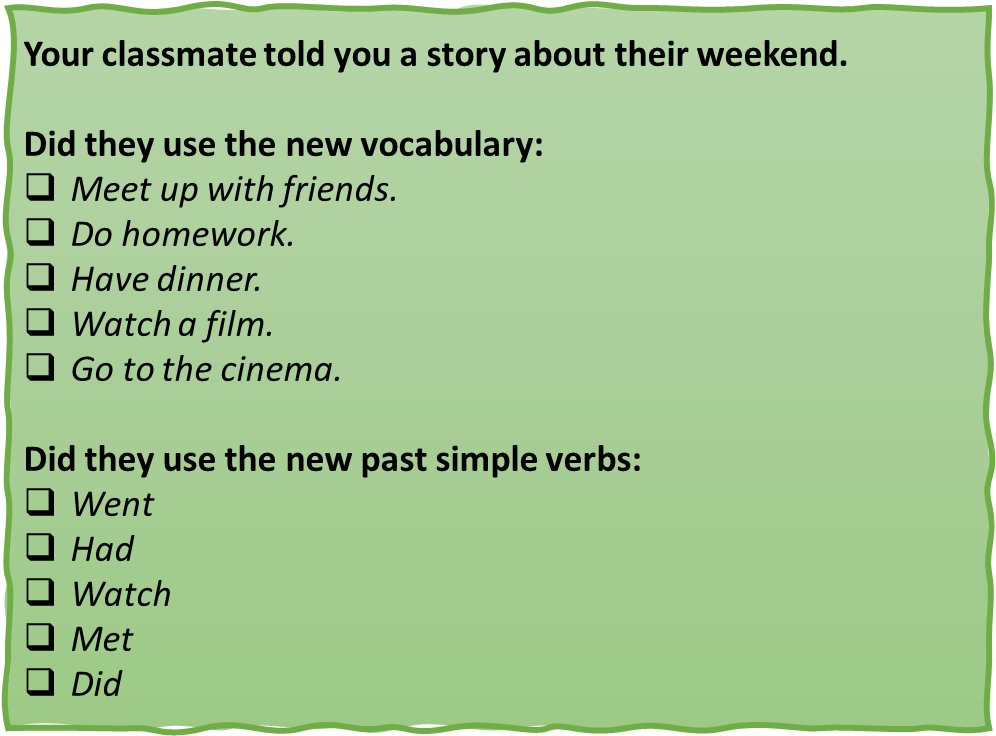
Success for a task can be laid out as using a specific piece of grammar or a number of items of lexis. Students can easily give peer feedback with short tick-boxes. The below can be easily used so students can choose their own lexis and their own level of success. It can be used as a peer-assessment or adapted for self-assessment.
This is fine with lower levels but my students are advanced and it is harder for them to see progress and reflect.

100% agree with the core of this statement. At higher levels it is more difficult for students to see their progress as it’s much less tangible. This, however, makes it even more crucial that learners are given the opportunity to reflect on and discuss what they’ve learnt. Without these discussions, students may come to the conclusion that they are not progressing because it is less tangible and visual.

At higher levels, students can converse easily on a range of topics. They can draw on their known, safe language and complete communicate tasks with relative ease. It is important therefore that we give them the opportunity before the task to make decisions about new language and skills they want to attempt, encouraging them to move outside their comfort zones. And then to reflect on how successful they were and what they want to try next time.

This is fine with adults but my students are too young to reflect and discuss their learning.

Most of my experience has been with older students, and while I have taught younger students, it is a number of years ago now. However, recently I got the chance to sit in on my 5-year-old son’s lesson. He was writing some words about a picture they had drawn. They were learning to write words to describe body parts. The teacher modelled it and then checked success criteria:

  • Where do we write? Chorus: under the picture.
  • How many words do we write on each line? Chorus: one.
  • Which words are we writing? Chorus: body word.

Students went off and wrote their words. Afterwards the teacher asked them to give their partners feedback using thumbs up or down while she moved around. She called out the success criteria again and students gave their partners thumb-based peer feedback.

Like anything, we grade the task. It’s all possible but needs to be scaffolded for the age or level. Here’s a nice idea for teaching writing using images of cupcakes the visualise layers of success.

This is fine but my students are from an educational background where they expect the teacher to give input the whole time. They’re not able to reflect.

There are so many things that we take for granted in an English language lesson that are not standard in every educational background. Depending on your age or culture, working with a partner may not be something you expect in class, but we do it because we know the value. For many students, being taught lexically might jar with their expectations but many teachers will persevere, confident that this is the best way for their students to learn.

Like anything, given the support and scaffolding, students will learn what is expected of them in class. Patience and understanding will often be necessary but if you feel that the discussion of learning is worthwhile and beneficial for them, then it’s worth spending the time helping your learners to develop those skills.

This is fine by my students want to focus on grammar and vocabulary input. There is not time for reflection and discussing learning.

As above really. If you value it, then it’s worth spending the time on it. The expectation of many students is that their lessons should be full of input so they can fill their notebook with notes which they may never look at again. What’s more important than every student knowing how much they’ve progressed in a lesson and knowing what they need to work on. Without discussing learning, this won’t happen. We’ve got to value these discussions and make the space in the lesson.

This is fine but I tried to do reflection tasks and my students couldn’t do it.

Giving peer feedback, reflecting on success or discussing your progress are not easy skills. However, they are skills that will help our learners in language learning but also in their lives beyond the classroom. They are valuable skills. The first time you try it with your students, they may struggle or balk as reflecting on input isn’t as easy as receiving and recording input for many. My advice would be:

  • Scaffold it carefully.
  • Do it little and often.
  • Don’t be put off if it’s tricky the first time. Persevere…it’s worth it.

This is fine but there are 50 students in my class so I can’t do this with them all.

The bigger your group, the more crucial it is that your learners are developing the skills they need to self-assess, peer-assess, reflect, and give feedback. With a large group, there is no way that a teacher can be expected to give meaningful feedback to everyone or assess their progress. The best we can do is develop the skills above and help our students to become more autonomous.

Let’s bring it all back home.

It’s not that we disagree with any of the above challenges. They are all challenges. However, if we believe in the value of these discussions and so we urge you to persevere and make it possible for your learners. They can all do it…they might just need your support.

Overt Materials: There’s space on the page.

I remember my first teaching position. It was 2009. I walked in the door, was handed a coursebook, a register and some CDs and told to head across the road where my classroom was. There I found an old building with several classrooms and no teachers room. Over the next six months, I learnt to teach from the only support I had, which was my coursebook.

Let me stop for a second to say that coursebooks are wonderful. I love them. But in an industry in which many teachers at best have a four-week course under their belt and at worst begin teaching with no relevant qualifications to speak of at all, coursebooks play a huge role in shaping and influencing the type of teachers we become. This is not a role that should be taken lightly.

What did I learn in those first 6 months?

I learnt a lot. I learnt that grammar was the key to learning a language. Every unit was built around the grammar. The point of the lesson was to teach the grammar. I learnt that being a good teacher meant learning all the grammar and presenting it in an interesting way.

I learnt that teaching listening meant carrying out a comprehension checking activity. From unit after unit of comprehension checking activities I learnt that practice was supposed to make perfect. I learnt that a good teacher constantly tested their students’ listening comprehension.

I learnt that teaching meant covering information. It meant completing the reading and listening activities. Doing the vocabulary exercises. Teaching the grammar. Practising it in gap-fill exercises and speaking tasks.

How do I feel about those lessons I learnt?

Well, over the past decade I’ve spent my time teaching, researching, attending conferences and chatting to colleagues and I’ve learnt that maybe not everything above had a positive impact on my students’ progression. I’ve had to gradually unlearn a lot of those potentially damaging lessons.

I’ve learnt that presenting the grammar in an interesting way doesn’t necessarily mean my students are any better equipped to use it when it counts.

I’ve learnt that being a good teacher doesn’t just mean mastering all the grammar points.

I’ve learnt that practice does not necessarily lead to perfection when it comes to listening.

I’ve learnt that a successful lesson doesn’t mean covering information, it means helping your students reach a goal. A successful lesson is one in which your students know what that goal is and can both see and discuss their progress.

I’ve learnt that giving my students input means nothing without them having the opportunity to reflect on what they’ve learnt and how they can use it in their lives beyond the classroom.

I’ve learnt that teaching isn’t about me, it’s about them.

Haven’t coursebooks changed too?

Coursebooks play a valuable role in our industry. As mentioned above, they can choose to drive standards and challenge outdated norms of teaching. In my time in the industry, I’ve seen huge changes.

The lexical approach was not new when the Outcomes series was released but because this approach was now visible on the page, gradually teachers who used these books were learning a new way of dealing with language and grammar in the classroom.

With the release of the Voices series, countless teachers around the world are now incorporating inter-cultural communication into their lessons because it is there on the page.

It is amazing to see new coursebooks coming out and paying attention to the changing world of language learning. As we see fewer coursebooks with pictures of London buses and tube stations in every unit, gradually English language learning becomes less England-centric and focuses more on global English.

But is there space for anything else on the page?

Our industry has come so far and it’s incredible seeing how materials have changed and grown over the years. However, I believe there is still space on the page for discussion. Not just the discussion of content but the discussion of learning.

Many teachers may be having these discussions with their students, but that can be a lot to ask of newly qualified teachers. By giving the below space on the page, we highlight their importance and give both teachers and students the tools they need to discuss learning and impact.

  • Real-life objectives.
  • Clear aims.
  • The discussion of the aims and objectives.
  • The creation and discussion of success criteria.
  • Reflection tasks.

For more information on each of these areas, check out our blog on Overt Teaching or our book on Overt Teaching. If you’re interested in materials that put the discussion of learning on the page, try this low-level lesson on using the past simple to tell stories. This worksheet includes aims and objectives, discussion of these aims, success criteria and reflection on progress on the page.

Howard’s End: Reading for natural reactions – high level learners

So, the origins of this lesson go back to the sunlight times when I taught the Cambridge Exams. Forster’s Howards End was a set text for, I think, CPE. I always loved the three letters that begin the book and those who have followed this blog for a long time will know a lot of the earlier lessons had a literature base. This then, is a return of sorts.

The text itself gives us the chance to do some Danny Norrington-Davies style grammar activities and the chance to really look at how we examine gist.

As always when I use some Literature in class it is only fair to draw attention to Gillian Lazar’s excellent book: Literature and Language teaching.

There is a lot of reading in this lesson and this gives us the chance to look at prepositions as part of chunks of language.

  • Level: advanced C1/C2 (High upper Ints could maybe manage if scaffolded well)
  • Aim: to examine tone and how it is conveyed in an authentic text
  • Time: 2-3hrs

Materials:

Procedure:

For all of these activities I would recommend asking the students to look on their own first and then work in pairs or groups.

Reading and Reaction

The reading here aims to give the students the chance to react more naturally to the text than the standard gist questions. Answers obviously some are subjective here. Your job is to probe the reasoning. I have put some answers below. I would give them time to read, and then put them into groups to answer the questions.

  1. How old do you think Helen is? (Why?) perhaps young – refers to aunt, whole style of the piece
  2. What is the relationship between Helen and Meg? sisters
  3. Who do you think Tibby might be? brother
  4. Who are the Wilcoxes and where did Meg and Helen meet them? family they met while travelling
  5. What is the impression given of the Wilcoxes? Sporty – different from Helen’s family

However, accept any reasonable answers. Here the key is to encourage the students to engage and come to their own conclusions.

Vocabulary from context and co-text

This activity is about building a skill rather than teaching ‘key’ lexis. We want the students to be able to work out meaning from context and co-text. The students will enver need the word wych-elm, but they will need to be able to see when a lexical set is being referred to as it is here.

  1. it is a tree and they can see this from the following sentence ‘I quite love that tree already’
  2. There are 6:

‘Also ordinary elms, oaks—no nastier than ordinary oaks—pear-trees, apple-trees, and a vine. No silver birches, though’

Focus students on the reflective activity, we want them to know why we have done the task. Ask them where they can use it next.

Grammar Focus

This is about moving away from established rules and looking at why a tense or structure is used and how they work together. This can be important as a lot of students can trot out the rules for tenses but don’t seem then seem to be able to use them productively. This type of activity aims to address that.

  1. mostly present simple as it is a series of descriptions of things as they are now. e.g. ‘it is old and little’
  2. This extract gives the chance to see different tenses interacting.

I looked out earlier, and Mrs. Wilcox was already in the garden. She evidently loves it. No wonder she sometimes looks tired. She was watching the large red poppies come out.

  • Which tenses are used here? past simple / present simple / past continuous
  • What difference in meaning do the different tenses show us here?
  1. Past simple – used for main activity in the anecdote
  2. Present simple – Helen’s comments on it
  3. Past continuous – an activity that happened over a period of time in the anecdote.

The interesting thing here is the present simple which is used in an interesting way. The other two tenses follow what we would expect in a story.

3. Now look at the conditional in the sentence below:

…if you shut your eyes it still seems the wiggly hotel that we expected.

  • What type of conditional is it? Does it refer to present / past / future / all time? 0 conditional talking about all time
  • Why is it used here? I think to give them impression of this being like a dream – the idea of being able to go back to their assumptions about the house and people who live there.

Reading and Reaction II

Now look at the letter again and answer these questions

  1. Is there anything unusual about the letter? things have been omitted, lots of fractured sentences, the use of burn this
  2. What impression does Helen give us about Aunt Juley? that she is boring
  3. Can you think of three adjectives to describe Helen? Any answers fine
  4. Use your phone to find a picture of what she looks like to you and compare with your neighbour. Any answers fine

Reading and Reaction III

All answers in this section are up to the students, you should put them into groups and let the students discuss them before coming together in all class feedback to check them.

Preposition focus

The aim here is to get the students to focus on chunks of text. Too often students think of prepositions without seeing them as part of larger chunks.

There is the secondary aim in that looking in the letters for the answers gives them scanning practise.

  1. We can scarcely pack in as it is
  2. … and there are the stairs going up in a sort of tunnel
  3. I must get on to my host and hostess
  4. … she kept on smelling it
  5. how good of her to come
  6. the others do not take advantage of  her
  7. I laugh at them for catching hay fever

Reflection

These questions are just to make them realise the point of the different activities so put them in groups to discuss and monitor.

There is a lot more you can do with this text if you wanted, but these are some hopefully interesting things.


The Cure (Pictures of You) – Present Perfect Continuous

This is quite a short one. I am a big believer in using music in the classroom but I like to use snippets of songs. I’ve always felt that if you use the whole song, you very often end up with students who hate the song. But, if you listen to one or two verses, they might go off and listen to it themselves.

If you would like to try other lessons using songs or snippets of songs, you could try:

  1. here
  2. or here
  3. or even here
  4. or maybe here
  5. Orrrrrrr…here
  6. Or finally, here
  7. …or here

I really like this song as they used present perfect continuous when I feel present perfect would have worked just as well. It’s the perfect opportunity for students to consider why someone might choose one over the other. The continuous aspect really conveys the singers emotion and emphasises how long they feel these actions have been going on for.

Having recently seen the wonderful Danny Norrington-Davies at the ELT Ireland conference, I have decided to take his approach to the grammar for this lesson. I have asked the students why the writer has used the Present Perfect Continuous and I want them to go beyond “It’s an action that started in the past and continued to the present and is still continuing”. I want to hear about the emotion that is being conveyed.

I’ve been looking so long at these pictures of you.

That I almost believe that they’re real.

I’ve been living so long with my pictures of you

That I almost believe that the pictures are, all I can feel.

Objective:

By the end of the lesson, the students will be more aware of the emotion that can be conveyed through the present perfect continuous.

Time: 1 hour (max)

Level: Intermediate and above

Material:


Procedure:

Intro:

  • T should fold the handout in half so that sts cannot see the lyrics.
  • T instructs sts to discuss the opening questions in small groups and then feeds back as a class.
  • This is a nice opportunity to look at language to discuss music. I’ve included “Taste in music” but I think others will emerge naturally e.g. “I’m not a fan of” “It’s not for me” “I’m not really into X music” “I’m more of a X person”.

Listening

  • T plays the opening 2mins of the song (or as much as they feel is necessary) and instructs sts to listen and consider the questions at the beginning of the listening section.
  • Sts discuss in pairs.
  • This is a nice opportunity to introduce the chunk “It makes me feel X” or “It sounds (like)”
  • T tells the students that this is a song by The Cure and it is on Youtube if they would like to listen to the whole song. Today, they are just going to listen to about 10 seconds of it and they will be using it for both grammar and pronunciation.
  • T plays the first verse (starting at about 2mins 35) and instructs sts to write everything they hear in the empty box. T replays the first verse 2-3 times and sts write down whatever they hear. After each play, give sts time to check with partners.
  • T instructs sts to unfold their handout and check their answers. Sts should circle any words they didn’t hear / heard incorrectly.
  • This is a wonderful chance for some listening skills reflection. Encourage sts to reflect on what / why they didn’t hear it. Was it:
    • because of the music? They will often have music in the background when listening. Is there anything they can do to help them in this situation?
    • because of the accent? What in particular surprised them? Focus on these words/phrases and drill them.
    • because of the vocabulary? Which words were new?
    • because of weak forms and connected speech? See Pron focus section

Language Focus

  • T directs sts to the language focus section (putting extra importance on the third question). Sts discuss the questions in pairs. T moves around and helps where necessary.
  • At this point you will find sts regurgitating a Raymond Murphy style explanation of the present perfect continuous. Try to discourage this and encourage sts to think why the writer chose to use this tense. 
  • T gives the sts a post-it note and asks them to write down their answer to the third question. T collects, places them on the board and gets sts to crowd around the board in their pairs and discuss the suggestions. They should choose their favourite answer.
  • While they are still standing, discuss their ideas as a class.
  • You are looking for something like: The writer wants to convey that they feel these actions have been ongoing for a long time. They want to emphasise the time over the action. Their emotions are being conveyed through this tense. The writer could have used present perfect as well but it would not have conveyed the same emotion and would have highlighted the action instead.

Pronunciation Focus

  • T moves to the pronunciation section and replays the song to allow sts to decide how “been” and “can” are pronounced.
  • Sts have often been encouraged to pronounce “been” with /i:/ but in natural speech it is closer to /bIn/. “Can” becomes /kən/. Drill the chunks as a class, correcting where necessary. 

Practice

  • Sts write their own version of the lyrics below, either keeping the song as a sad one or perhaps changing it to a happier one. Sts make a choice on which tense to use.
    • you can either play the song and they all sing their versions together for fun.
    • or you can get sts to read them out and practise the pronunciation.


Is the English Language sexist?

So this lesson uses a fantastic newspaper article from the Guardian.

http://www.theguardian.com/commentisfree/2016/jan/27/eight-words-sexism-heart-english-language

It was one of those things I read and knew I had to make a lesson about.

The lesson focuses on collocation, vocab building and reading skills if you fancy going down that route, as ever, you are welcome to pick and choose bits and pieces.

Aims: build awareness of collocation / get students to respond to a text naturally

Level: Advanced / strong upper Ints could cope if it is scaffolded

Time: This really depends on how the conversation part goes but you will need a bare minimum of 1hr, I think 1.30-2hrs is more realistic.

Procedure:

Introducing collocation:

  1. Ask St’s in pairs to come up with 6 collocations for ‘Pop’ on the worksheet.  They can then read the first paragraph of the text to check if there collocations were the same.
  2. Write the word ‘Rabid’ on the board. Now ask students to look at the second paragraph and look for the collocation for the word rabid.  Ask them to think about what the word ‘rabid’ means.
  3. Ask them to complete the second diagram using words from the text.
  4. Ask students to think about recording their new vocab along with words that collocate with them, to help them to be more natural when speaking and writing.  You could at this point direct them to the British National Corpus, or show them how to look for collocations online from any other sites you may use.

http://phrasesinenglish.org/searchBNC.html

Reading:

Feel free to completely change this section adding gist questions or scanning tasks, but what I wanted here was two things:

  • to get students to react in a more natural way to the text.
  • to get students to create their own questions to set for each other. ( I should add here that it was partly to encourage learner autonomy and to test their ability to write synonyms but also to get them to think about how an examiner might write the question.  Therefore, I monitored them closely, helping with synonyms and little grammar fixes here and there).

You could, if you have a nice even number, cut up the 8 words and get the students to read them and then tell the other students about them, a jigsaw reading of sorts.

Otherwise follow the questions on the worksheet.

Reflection:

Having had a chat to a friend about some of the attitudes of her students recently, I was keen to put a reflection section into this lesson, they feature in lots of our lessons, but this one is thinking more globally about language.  This could result in a big discussion or be over in 6 minutes, really depends on your students.  Go with whatever feels right.

Vocabulary:

Again, as part of training students to be more autonomous the idea here is to get them to try to work out the meaning of words using their context.  They can then check them against a-f

As always, if there are any changes you put in, let us know and tell us how it goes.

Materials:

Office Politics – Listening

So, this is a little listening lesson, pretty tricky unless it is scaffolded properly.  It also shows students some conditionals in a natural situation, which is always a plus in my book, it can conveniently fit into either a lesson on work or comedy, but for the purposes of this, it is as a bit of a break from a unit/week on work.

Do let them listen a few times, especially at the beginning, as it is pretty fast.  Your job as teacher is to stop them getting discouraged and to explain that the reason for this is to try to bridge the gap between what they do inside the classroom and what happens outside those walls.

Enjoy

Aims: expose students to real conversation, show grammar, conditionals, in a real context, focus on pronunciation, sentence stress.

Time: 1hr +

Level: High int +

Procedure:

The worksheet should be fairly easy to follow so the procedure would be to follow that, rather than me writing a lengthy one here.  But do have a look before you go into class as i’ve tried to really mix the activities, listening as the main background activity with lots of things coming off it

I would recommend putting in the time for students to reflect on what they have seen as for this I think it is important for all lessons, but especially this one.

Here are the answers to the word stress exercise at the end, feel free to disagree but this is what I hear.

T. Hey dude

G. Give it back

T. I’m just using it for a second

G. It’s got my name on it, Gareth

T. No, it says Garet, actually, but

G. Ask if you want to borrow it.

T. Yeah, you always say no mate, so what’s the point

G. Perhaps that’s why you should ask

T. Gareth it was just there ok

G. Yeah, that’s its home, leave it there.

Also, you could obviously go onto connected speech at this point or other pronunciation features, depending on how your students are feeling.

Materials

Worksheet: the-office-worksheet

Video: https://www.youtube.com/watch?v=U1PHpkdvNOs