Over the past few months, I’ve been speaking to a lot of teachers about the emergence of AI and its impact on our industry. Reactions have ranged from fear to acceptance to excitement. It’s a really interesting time to be a teacher. I have to say, I understand the fear. For the majority, it’s not about machines rising against us or homicidal interactive whiteboards. For many it’s a fear of the unknown, we just got used to teaching online and now there’s another new piece of software we need to get to grips with, another tool that our students will be more familiar with than us. And that is very understandable.
In answer to that fear, I would say just try it out. Start small and take it from there. You don’t need to be the expert. It’s all about the first step. In this post, we’ll look at making that first step as easy as possible.
What problem can AI help to solve?
An easy first step is finding something you do regularly and explore how AI can help you achieve that more effectively. As a teacher, I remember spending hours scouring the internet looking for the perfect texts to use in my lessons, the perfect dialogue, story, article, etc. I’d come across one and it would be almost perfect but not quite. If you’ve ever had this issue, Artificial Intelligence is going to become your best friend.
For the purposes of this blog, we’re going to use Chat GPT. It’s free, easy to sign up to and easy to use.
Step 1: Sign up to ChatGPT
- Go to Chat GPT and set up an account.
Step 2: Decide what kind of text you want
What is the objective of your lesson? What kind of text would help you to achieve that objective? Is it a short story, an article, an anecdote, a poem, a dialogue, a text conversation? Whatever it is, Chat GPT will help you to write it.
Step 3: Get your prompt right
The key to getting the text you want is feeding Chat GPT the information it needs. For example, if you say “write me a story about a night out”, you might get a story that’s 1000s of words long or you might get a very short one. It might be a love story, a horror story, or a combination of both. You’re at the whim of Chat GPT. It’s all about the prompt. To ensure success, include:
- Request:
- Genre:
- Length:
- Student profile:
- Level:
- Key grammar points to include:
- Key vocabulary to include:
Step 4: Edit your text
The beauty of Chat GPT is that if you don’t like your text, you can just click “Regenerate” and you’ll immediately get another version. You can also ask Chat GPT to refine your text by feeding it further prompts. For example, you could say: “please make this story shorter” or “please make the vocabulary a little simpler” or even “please rewrite this story in the first person”.
In my experience, you’ll probably still need to edit the story slightly to make it perfect for your specific group of students, but Chat GPT will do most of the heavy lifting for you and will do it in seconds.
Let’s look at an example:
I want to teach a lesson on telling stories using a range of narrative tenses. My topic is nights out. I asked Chat GPT to create a text for me. Using the prompt structure above, I fed it the information it would need.
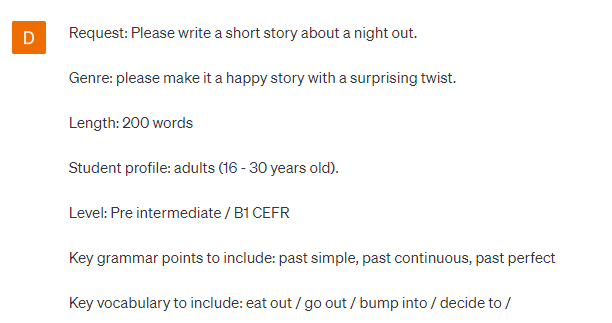
Chat GPT created the story below, which is a pretty good start but I felt there was some vocabulary that wasn’t really appropriate for this level.
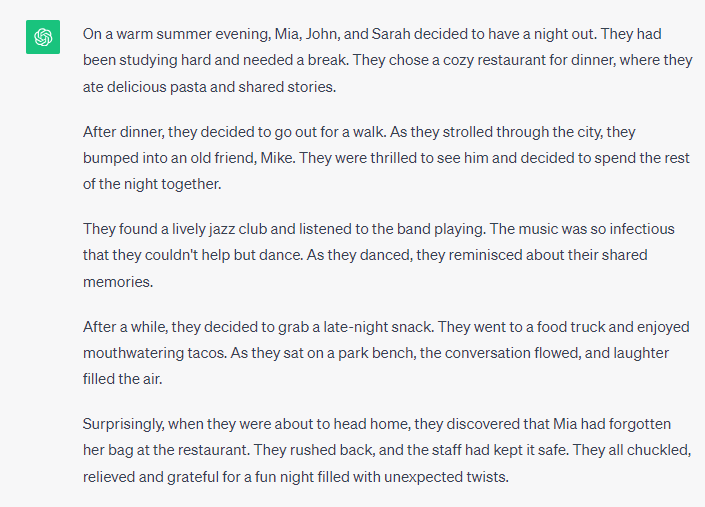
I asked Chat GPT to replace the vocabulary with simpler vocabulary and got the following. This was pretty good but I wanted my students to tell their stories from the first person to better mirror how they tell stories in their real lives.

I asked Chat GPT to rewrite it from the 1st person point of view and thankfully it obliged.
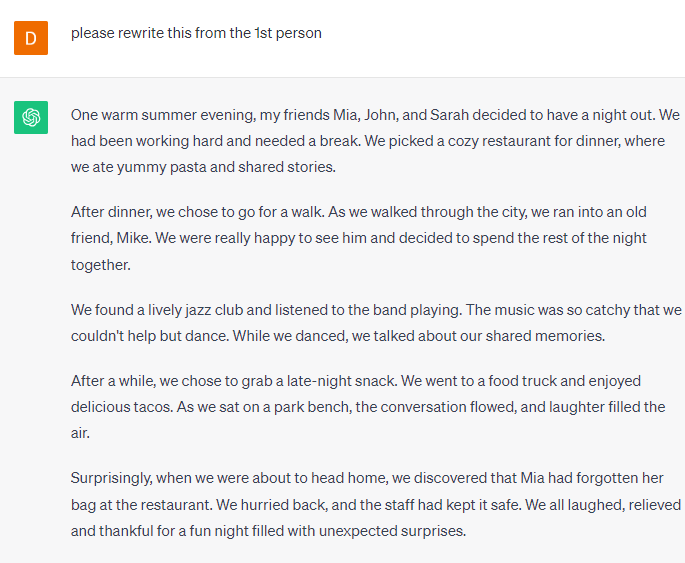
I’ve now got a pretty decent text, at the level I want, in the format I want and the beauty of this is that it took about 2 minutes from start to finish.
A Final Thought:
AI isn’t perfect in any shape or form but it can save you a lot of time when it comes to lesson planning and materials creation, even if it’s just to give you some inspiration. So, before you go scouring the internet for the perfect text, why not take that first step and give AI a go. It’s not as scary as it might seem.
Let us know how it goes.
 textploitation