I think we should discuss learning…but MY students can’t do it!

Mark and I write and speak a lot about Overt Teaching. If you’d like to know more about what that is, you can read our blog post here or check out our handy dandy book, available on all good book websites and probably in the dark corner of a bookshop where they keep the rest of the EFL methodology books.

The core of Overt Teaching is that we believe we should be involving our learners in the discussion of learning throughout our lessons. We should be discussing the objectives of our lesson and helping learners to relate it to their lives and goals; we should discuss why we do what we do with our students, what our aims for a task are; we should give students the tools they need to reflect on their own success and give their peers feedback. And why? Because a more aware and invested student will be more engaged and make more progress.

In general when we talk about this at conferences or just one to one, our points and ideas are met positively. We’ve met very few teachers who really believe that it is a bad course of action or who do not want learners engaged with the learning process. However, we do often encounter some push back and it tends to be in the form of:

This is great but my students couldn’t do this.

There tend to be a number of reasons why teachers believe that their students would not be able to discuss learning but below are some of the most common, and a summary of some of the discussions we’ve had.

This is fine with higher levels but my students are too low. They don’t have the language you need to reflect.

Of all the levels, learning is most tangible at the lower levels. It can sometimes be as simple as “at the beginning of the lesson, you couldn’t talk about the past, now you can”. Very often reflection is viewed as a complex abstract topic that must be delved into in great detail. However, at beginner, elementary or pre-int, reflection at the end of a lesson can be a simple discussion:

  • What vocabulary did you learn today?
  • What grammar did you learn today?
  • How will you use it outside class?

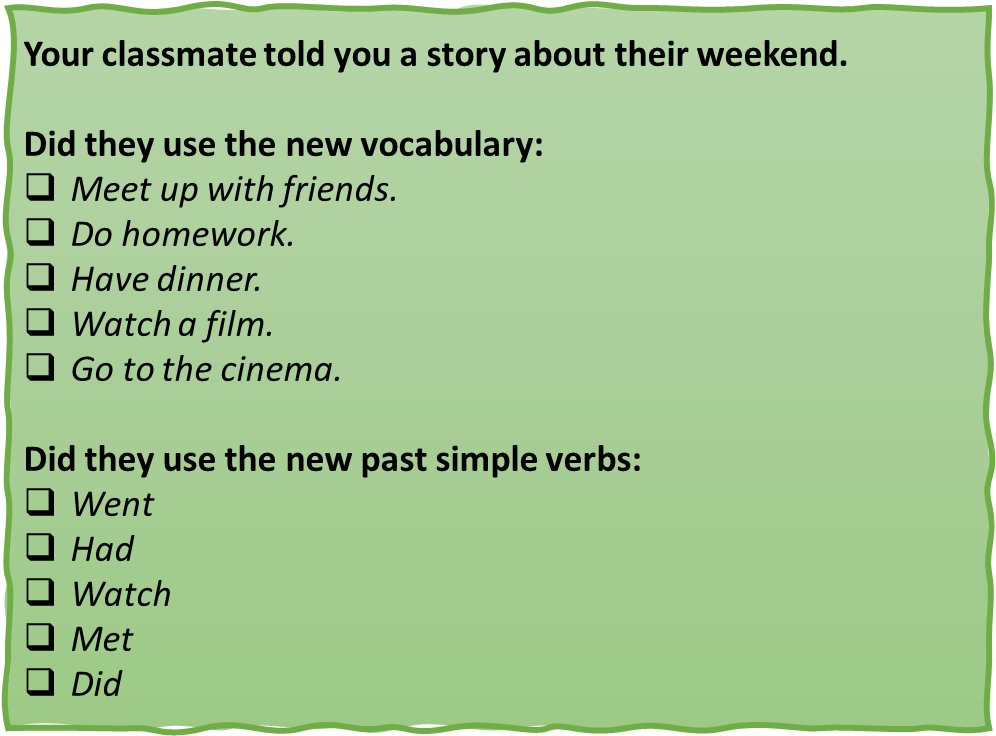
Success for a task can be laid out as using a specific piece of grammar or a number of items of lexis. Students can easily give peer feedback with short tick-boxes. The below can be easily used so students can choose their own lexis and their own level of success. It can be used as a peer-assessment or adapted for self-assessment.
This is fine with lower levels but my students are advanced and it is harder for them to see progress and reflect.

100% agree with the core of this statement. At higher levels it is more difficult for students to see their progress as it’s much less tangible. This, however, makes it even more crucial that learners are given the opportunity to reflect on and discuss what they’ve learnt. Without these discussions, students may come to the conclusion that they are not progressing because it is less tangible and visual.

At higher levels, students can converse easily on a range of topics. They can draw on their known, safe language and complete communicate tasks with relative ease. It is important therefore that we give them the opportunity before the task to make decisions about new language and skills they want to attempt, encouraging them to move outside their comfort zones. And then to reflect on how successful they were and what they want to try next time.

This is fine with adults but my students are too young to reflect and discuss their learning.

Most of my experience has been with older students, and while I have taught younger students, it is a number of years ago now. However, recently I got the chance to sit in on my 5-year-old son’s lesson. He was writing some words about a picture they had drawn. They were learning to write words to describe body parts. The teacher modelled it and then checked success criteria:

  • Where do we write? Chorus: under the picture.
  • How many words do we write on each line? Chorus: one.
  • Which words are we writing? Chorus: body word.

Students went off and wrote their words. Afterwards the teacher asked them to give their partners feedback using thumbs up or down while she moved around. She called out the success criteria again and students gave their partners thumb-based peer feedback.

Like anything, we grade the task. It’s all possible but needs to be scaffolded for the age or level. Here’s a nice idea for teaching writing using images of cupcakes the visualise layers of success.

This is fine but my students are from an educational background where they expect the teacher to give input the whole time. They’re not able to reflect.

There are so many things that we take for granted in an English language lesson that are not standard in every educational background. Depending on your age or culture, working with a partner may not be something you expect in class, but we do it because we know the value. For many students, being taught lexically might jar with their expectations but many teachers will persevere, confident that this is the best way for their students to learn.

Like anything, given the support and scaffolding, students will learn what is expected of them in class. Patience and understanding will often be necessary but if you feel that the discussion of learning is worthwhile and beneficial for them, then it’s worth spending the time helping your learners to develop those skills.

This is fine by my students want to focus on grammar and vocabulary input. There is not time for reflection and discussing learning.

As above really. If you value it, then it’s worth spending the time on it. The expectation of many students is that their lessons should be full of input so they can fill their notebook with notes which they may never look at again. What’s more important than every student knowing how much they’ve progressed in a lesson and knowing what they need to work on. Without discussing learning, this won’t happen. We’ve got to value these discussions and make the space in the lesson.

This is fine but I tried to do reflection tasks and my students couldn’t do it.

Giving peer feedback, reflecting on success or discussing your progress are not easy skills. However, they are skills that will help our learners in language learning but also in their lives beyond the classroom. They are valuable skills. The first time you try it with your students, they may struggle or balk as reflecting on input isn’t as easy as receiving and recording input for many. My advice would be:

  • Scaffold it carefully.
  • Do it little and often.
  • Don’t be put off if it’s tricky the first time. Persevere…it’s worth it.

This is fine but there are 50 students in my class so I can’t do this with them all.

The bigger your group, the more crucial it is that your learners are developing the skills they need to self-assess, peer-assess, reflect, and give feedback. With a large group, there is no way that a teacher can be expected to give meaningful feedback to everyone or assess their progress. The best we can do is develop the skills above and help our students to become more autonomous.

Let’s bring it all back home.

It’s not that we disagree with any of the above challenges. They are all challenges. However, if we believe in the value of these discussions and so we urge you to persevere and make it possible for your learners. They can all do it…they might just need your support.

Overt Materials: There’s space on the page.

I remember my first teaching position. It was 2009. I walked in the door, was handed a coursebook, a register and some CDs and told to head across the road where my classroom was. There I found an old building with several classrooms and no teachers room. Over the next six months, I learnt to teach from the only support I had, which was my coursebook.

Let me stop for a second to say that coursebooks are wonderful. I love them. But in an industry in which many teachers at best have a four-week course under their belt and at worst begin teaching with no relevant qualifications to speak of at all, coursebooks play a huge role in shaping and influencing the type of teachers we become. This is not a role that should be taken lightly.

What did I learn in those first 6 months?

I learnt a lot. I learnt that grammar was the key to learning a language. Every unit was built around the grammar. The point of the lesson was to teach the grammar. I learnt that being a good teacher meant learning all the grammar and presenting it in an interesting way.

I learnt that teaching listening meant carrying out a comprehension checking activity. From unit after unit of comprehension checking activities I learnt that practice was supposed to make perfect. I learnt that a good teacher constantly tested their students’ listening comprehension.

I learnt that teaching meant covering information. It meant completing the reading and listening activities. Doing the vocabulary exercises. Teaching the grammar. Practising it in gap-fill exercises and speaking tasks.

How do I feel about those lessons I learnt?

Well, over the past decade I’ve spent my time teaching, researching, attending conferences and chatting to colleagues and I’ve learnt that maybe not everything above had a positive impact on my students’ progression. I’ve had to gradually unlearn a lot of those potentially damaging lessons.

I’ve learnt that presenting the grammar in an interesting way doesn’t necessarily mean my students are any better equipped to use it when it counts.

I’ve learnt that being a good teacher doesn’t just mean mastering all the grammar points.

I’ve learnt that practice does not necessarily lead to perfection when it comes to listening.

I’ve learnt that a successful lesson doesn’t mean covering information, it means helping your students reach a goal. A successful lesson is one in which your students know what that goal is and can both see and discuss their progress.

I’ve learnt that giving my students input means nothing without them having the opportunity to reflect on what they’ve learnt and how they can use it in their lives beyond the classroom.

I’ve learnt that teaching isn’t about me, it’s about them.

Haven’t coursebooks changed too?

Coursebooks play a valuable role in our industry. As mentioned above, they can choose to drive standards and challenge outdated norms of teaching. In my time in the industry, I’ve seen huge changes.

The lexical approach was not new when the Outcomes series was released but because this approach was now visible on the page, gradually teachers who used these books were learning a new way of dealing with language and grammar in the classroom.

With the release of the Voices series, countless teachers around the world are now incorporating inter-cultural communication into their lessons because it is there on the page.

It is amazing to see new coursebooks coming out and paying attention to the changing world of language learning. As we see fewer coursebooks with pictures of London buses and tube stations in every unit, gradually English language learning becomes less England-centric and focuses more on global English.

But is there space for anything else on the page?

Our industry has come so far and it’s incredible seeing how materials have changed and grown over the years. However, I believe there is still space on the page for discussion. Not just the discussion of content but the discussion of learning.

Many teachers may be having these discussions with their students, but that can be a lot to ask of newly qualified teachers. By giving the below space on the page, we highlight their importance and give both teachers and students the tools they need to discuss learning and impact.

  • Real-life objectives.
  • Clear aims.
  • The discussion of the aims and objectives.
  • The creation and discussion of success criteria.
  • Reflection tasks.

For more information on each of these areas, check out our blog on Overt Teaching or our book on Overt Teaching. If you’re interested in materials that put the discussion of learning on the page, try this low-level lesson on using the past simple to tell stories. This worksheet includes aims and objectives, discussion of these aims, success criteria and reflection on progress on the page.

Front-loading: the enemy of learning

There is one movie trope above all others that really bugs me. You’ll see it occur in almost ever film set in a school. The students are in class, the teacher is explaining some crucial aspect of the lesson, the students are all slumped over their desks or tapping their pens, and then it happens…right in the middle of the teacher’s key input stage the bell goes off and just like that the lesson is over. The students pile out of class while the teacher shouts something along the lines of, “Read pages 40 to 400 and we’ll pick this up tomorrow!”

Then my poor wife has to pause the film and listen to me rant for the next ten minutes:

“But, but, they knew the bell was coming! The lesson is presumably the same length every day. It wasn’t a surprise. Why are they so bad at planning that they are surprised by the bell every day?! What happened in the first half of the lesson that caused them to be so off on their timings that they’re only getting to the main input stage in the final moments of the lesson! HOW IS ANYONE MEANT TO LEARN ANYTHING IN THESE LESSONS?!”

Then we carry on with the film and I silently seethe. Sometimes I ponder one question from my rant: what happened in the first half of the lesson? And sometimes I reflect on my own teaching and realise that while I was maybe never as bad as this movie trope, I was often guilty of front-loading my lessons to the detriment of my lesson objective.

Especially in my early years of teaching, I had a fear. A fear that informed how I planned and taught my lessons. It was a simple fear but if I’m honest, it had a serious impact on my students’ learning. What was it? It was the fear of running out of material before the end of my lesson. This fear of dead lesson time causes me to front-load.

What do I mean by “front-loading”?

If we imagine the average English language lesson will include the following major stages:

  1. Schemata activation discussion.
  2. A reading or listening text.
  3. Comprehension checking questions.
  4. Vocabulary input and practice.
  5. Grammar or skill input.
  6. Controlled practice of the grammar.
  7. Freer practice of the grammar.
  8. Feedback.

Front-loading occurs when a teacher spends the majority of their lesson time on stages 1 to 4, often supplementing with extra readings, listenings, or activities that relate to the topic. While these stages are important, it could be argued that they are the set-up for the input, practice, and feedback stages in which the real learning of the lesson occurs and learners will see real progress. This is not to say that the first stages are unimportant in any way, that set-up and schemata activation is hugely important but when front-loading occurs, it tips the balance of importance in favour of the set-up.

Where does “front-loading” come from?

Much like my early years of teaching, it is born from a fear that we will be left with empty lesson time and nothing to fill it. It comes from the belief that the material we have is not enough for the time we have. In my case this fear and belief persisted despite constant evidence to the contrary, despite always having to squeeze the most important stages of the lesson into the time left over.

How can we avoid “front-loading”?

Simple: plan less, teach more. When I am planning a lesson, I have to force myself not to front-load, not to spend too long on that opening discussion just because it’s interesting. The discussion is not my objective. The second half of the lesson is where the real learning occurs The first half is the set-up for the learning, it is just the context.

Below are some tips I employ to avoid front-loading:

  • Tip 1: I try to avoid supplementing with topic-based material. My learners might need more input or practice on the target language or skill but they probably don’t need another reading on the topic or another topic-based vocabulary exercise on top of what is already there. Any necessary lexis can emerge throughout the lesson.
  • Tip 2: Comprehension checking tasks aren’t always crucial to achieving my learning objective. If my objective isn’t to improve reading or listening comprehension, then maybe my lesson time is better spent on practice and feedback. I will often instead focus on the language within the text that will help my learners achieve their objective.
  • Tip 3: I remind myself constantly that it is ok to have time left over at the end of the lesson because:
    • Giving students the chance to repeat an activity and improve based on the feedback I’ve given, is an excellent use of class time.
    • Reflecting on what has been learnt in the lesson is worthwhile and my learners will benefit from this discussion.
    • Giving students time to consider how they will use the language they’ve learnt outside the classroom can help bridge the gap between the lesson and the real world, which is something I am constantly trying to achieve.

So, if you find yourself spending two thirds of your lesson on the set-up and squashing the actual learning into the final third, then avoid becoming a film trope and plan less, teach more.

For whom do aims and objective toll if not for thee

I LOVE clear aims and objectives in a lesson. When I see a group of students and a teacher who know what they’re learning and why they’re learning it, I go all warm and fuzzy inside. But I hate useless admin, admin for the sake of it. I can’t stand the statement “we’ve always done it this way” it makes me the opposite of warm and fuzzy inside…chilly and smooth?

Recently I had a conversation with a teacher that made me go a bit chilly and smooth but I do not think this is an isolated occurrence. In fact I remember feeling this very way in my early years as a teacher. We were discussing aims and objectives and he said:

“I don’t know if anyone else feels this way but I always write my aims and objectives because I know I have to but I don’t know who they are for? Are they for me, are they for my students or are they for the British Council?”

And there it is…I’m chilly and smooth. The one statement worse than “we’ve always done it this way” is “we do it for accreditation” or in the UK, “we do it for the British Council” [shudders]. Because yes of course there are things that we do in a school that when our accreditation bodies arrive, we will display proudly. And there are things that accreditation bodies will look for in a school. And one of those things will be aims and objectives…but not so they can tick a box, not so we can tick a box, but because behind every accreditation criterium lies a very good reason, a justification for its existence.

Aims and objectives for aims and objectives sake are not a good thing…but a learner who knows what they are learning and how it will help them in their real life is most definitely a good thing. Aims and objectives are one way of achieving this.

So to answer this teacher’s question (and I should add here that this was an incredible teacher who was just trying to figure out how best to use aims&objectives in their lesson) I said:

“Aims and objectives are for your students first and foremost and should never be a tick box. They should be a talking point.”

From Tick Box to Talking Point

First of all a few tips on writing effective aims and objectives:

  • Write them in student friendly language. Remember who they are for.
  • Begin with your objective (what you want them to be better at by the end of the lesson)
  • Work backwards to write your aims (what do they need to learn to be better at this objective by the end of the lesson)
  • Make your objective real-life and relevant for your learners (“be able to use the present perfect & past simple” is not real life but “be able to describe your career” is)
  • Focus on function over form: Consider the difference between “learn to use the present perfect” and “learn to describe ongoing situations in my career using the present perfect”
  • Follow a pattern: Don’t change up how you write your aims & objectives every lesson. Follow a recognisable pattern and display them in the same place each lesson. This reduces the amount that learners need to process. They can focus on the key message.

If you follow the above, you should find yourself with effective aims and objectives but if you don’t do anything with them, then they are little more than a tick box. We need to move them to a talking point. They should be the basis of a discussion with your students. Consider the following:

At the beginning of your lesson:

Use the some or all of the questions below to open up a discussion:

  1. How will this objective help you in your real life?
  2. Which of these aims will be most challenging for you?
  3. Which of these aims are you already confident in?
  4. How confident are you?
  5. Is there anything else you think you’ll need to achieve this objective?

During your lesson:

Keep the conversation going. Learners will always focus on what’s in front of them. Just because you know why something is relevant, doesn’t mean it is immediately apparent for the students.

  1. Why do you think we learnt this?
  2. How will this help you achieve the objective?

At the end of the lesson:

The ideal situation is a learner who can take what they’ve learnt in the lesson and bring it into their real lives but too often the lesson ends at the door. Keep it going:

  1. How well do you feel you achieved the objective?
  2. How will you practise this in your real life?
  3. How will you apply what you learnt to your real life?
  4. Is there anything you need more practice on?
  5. How will you practise it?

Using the word “will” can be more powerful than “can” or “could”. It’s not about what is possible, it’s about them making a promise, a commitment to try this outside the classroom…and then it’s on you to follow up with them.

So if you’ve ever felt like you were writing aims and objectives for the British Council, try out some of the ideas above and remember who we should be writing them for.

Overt Teaching

Overt Teaching is something we have spoken about many times but never really written about…overtly. It is a part of our lessons, our procedures, our approach to teaching English but we’ve never really made the case for it on our blog…which seems odd.

No time like the present to sort that out.

What do we mean by Overt Teaching?

In our industry there has often been a tendency to hide what we are doing from our students. We sneak grammar in under the cover of darkness like spies crossing from East to West Berlin, afraid that our eagle-eyed students will notice the present perfect and completely disengage from the lesson. Or, we work towards the big reveal, the “ahhhhhh” moment when our students realise what we’ve been working towards this whole time.

The flaw with the above is that if our students don’t know what they’re doing and how it applies to their life, they’re much more likely to be disengaged. Equally, if we tell our learners we’re doing the present perfect, they are likely to disengage if they don’t see how it applies to their real lives.

Teaching overtly suggests that we involve our learners in the learning discussion throughout the lesson. Below are some key stages of the lesson when this can be easily applied.

Starting off on the right foot:

The beginning of your lesson is arguably the most important aspect as this is where we get all of our buy-in from our students. If we look in the average coursebook, considerable time and page space is (quite rightly) taken up with engaging our learners in the topic of the lesson. As an industry we recognise the importance of this but the actual aims and the objectives of the lesson are not given the same pride of place.

They are very often squashed into a tiny box in the top-left corner of the page. As teachers we very often display them on the wall or on a board or as part of our lesson plan that nobody looks at but why do we do this? Is it because our institution demands it? Is it so we can tick an accreditation box? Or, is it because we recognise that a clear understanding of what we’re doing and why we’re doing it is crucial to student engagement? If it is the latter, then we should be bringing it into our lesson, not as a monologue from the teacher but as a dialogue with our students.

Tip 1:

Have a clear distinction between your objective (the final outcome you are working towards) and your aim (the things you will cover in the class to help them achieve the objective successfully). Careful and consistent wording can help with this. Consider:

Today we are going to:

  • aim
  • aim
  • aim

So that you can:

  • Objective

Tip 2:

Make it a discussion and increase student engagement through simple questions:

  1. How will this objective help you in your real life?
  2. Which of these aims will be challenging for you?
  3. Which is most important for you?
  4. Which do you feel will be revision for you?

By involving our learners in this discussion, we put some of the learning responsibility on them. They have decided which aims they will need to focus on more; they have related the objective with their lives and decided how it will benefit them.

Setting up an activity:

Aims and objectives at the beginning of the lesson are crucial but it doesn’t stop there. Sadly, minutes after we’ve finished with the above discussion, our learners have probably forgotten what we’re working towards and are focusing on the interesting reading or listening exercise. Maybe they’re entirely focused on the grammar because they’re finding it challenging. Continued discussion throughout the lesson is key. We need to help our learners see that everything in our lesson is building towards the final objective; it’s not busy work, it’s not just stuff we’re doing, it’s building towards something greater.

Tip1:

Before or after an activity consider asking your students why it was important. For example, why did we just learn 6 new collocations to do with work? Because we’re going to need them later when we introduce our jobs. And will all of these collocations be useful for all of you? No, these 3 are useful for me but the others aren’t as useful because I don’t work in an office.

Or

Why did we just listen to that conversation? Because it was a model for the conversation we’re going to have later on.

These quick interactions help keep our students (and us) on track and moving towards our objective. Don’t expect them to have the above answers the first time you ask them though. As with anything, you will need to elicit and support your learners in coming to these realisations. Gradually, you can train them to understand why as opposed to just what they are doing.

Ending up on the right foot:

The beginning of the lesson is crucial to engagement but if you don’t actually reach the objective, you’ll lose your students’ trust the next time around. We’ve all been derailed mid-lesson and changed our plan because something more important has come up but how often do we communicate this to our students? It’s so important that we explain our decision-making process to them. We laid out our objectives and why they were important; if we veer from them, we owe it to our learners to explain why.

But lets assume we don’t get derailed. We reach our final production stage. We’ve spent 2 hours teaching vocabulary, grammar and skills that we now want our students to use in this final conversation. We set up the task and…none of them use the language! We’ve all been there but the question is what do we do about it?

Tip 1: Success Criteria

Very often our learners just forget what is expected of them. They’re keen to communicate so they fall back on what’s easy and use the language they had at their disposal at the beginning of the lesson. Clearly setting our your expectation before the activity is key. Ask your learners what a successful conversation looks like for them. Elicit that in order to be successful, they’ll have to use the language and skills from the lesson. The beauty of this is that everyone goes into the activity clear in their minds what success looks like but this can vary from one student to another. Success for a new student to the group might just be using the grammar correctly but for a stronger student, it might be combining the grammar and the new vocabulary. By opening it up to students and making it a dialogue, you move the responsibility for success back onto them. They’ve decided their own level of success and now they have to try to achieve it.

Tip 2: Repetition

Accept that you will have to do the final activity two or more times and plan this into your lesson. The first time students have the conversation, they are usually considering the content. They’re just trying to communicate and asking them to add in new language and skills is quite the load.

Let them have the conversation, then refocus them on the success criteria. Ask them to discuss whether or not they used the language from the lesson and then set the task up again. The second and third time round, content is not an issue anymore and they can focus on upgrading their language and skills.

Conclusion:

Overt Teaching doesn’t require you to change how you teach drastically, it just suggests you ask a little more of your learners. We all say we want more autonomous students…perhaps this is a first step. Throw back the curtain on your teaching & planning, let them in.