Front-loading: the enemy of learning

There is one movie trope above all others that really bugs me. You’ll see it occur in almost ever film set in a school. The students are in class, the teacher is explaining some crucial aspect of the lesson, the students are all slumped over their desks or tapping their pens, and then it happens…right in the middle of the teacher’s key input stage the bell goes off and just like that the lesson is over. The students pile out of class while the teacher shouts something along the lines of, “Read pages 40 to 400 and we’ll pick this up tomorrow!”

Then my poor wife has to pause the film and listen to me rant for the next ten minutes:

“But, but, they knew the bell was coming! The lesson is presumably the same length every day. It wasn’t a surprise. Why are they so bad at planning that they are surprised by the bell every day?! What happened in the first half of the lesson that caused them to be so off on their timings that they’re only getting to the main input stage in the final moments of the lesson! HOW IS ANYONE MEANT TO LEARN ANYTHING IN THESE LESSONS?!”

Then we carry on with the film and I silently seethe. Sometimes I ponder one question from my rant: what happened in the first half of the lesson? And sometimes I reflect on my own teaching and realise that while I was maybe never as bad as this movie trope, I was often guilty of front-loading my lessons to the detriment of my lesson objective.

Especially in my early years of teaching, I had a fear. A fear that informed how I planned and taught my lessons. It was a simple fear but if I’m honest, it had a serious impact on my students’ learning. What was it? It was the fear of running out of material before the end of my lesson. This fear of dead lesson time causes me to front-load.

What do I mean by “front-loading”?

If we imagine the average English language lesson will include the following major stages:

  1. Schemata activation discussion.
  2. A reading or listening text.
  3. Comprehension checking questions.
  4. Vocabulary input and practice.
  5. Grammar or skill input.
  6. Controlled practice of the grammar.
  7. Freer practice of the grammar.
  8. Feedback.

Front-loading occurs when a teacher spends the majority of their lesson time on stages 1 to 4, often supplementing with extra readings, listenings, or activities that relate to the topic. While these stages are important, it could be argued that they are the set-up for the input, practice, and feedback stages in which the real learning of the lesson occurs and learners will see real progress. This is not to say that the first stages are unimportant in any way, that set-up and schemata activation is hugely important but when front-loading occurs, it tips the balance of importance in favour of the set-up.

Where does “front-loading” come from?

Much like my early years of teaching, it is born from a fear that we will be left with empty lesson time and nothing to fill it. It comes from the belief that the material we have is not enough for the time we have. In my case this fear and belief persisted despite constant evidence to the contrary, despite always having to squeeze the most important stages of the lesson into the time left over.

How can we avoid “front-loading”?

Simple: plan less, teach more. When I am planning a lesson, I have to force myself not to front-load, not to spend too long on that opening discussion just because it’s interesting. The discussion is not my objective. The second half of the lesson is where the real learning occurs The first half is the set-up for the learning, it is just the context.

Below are some tips I employ to avoid front-loading:

  • Tip 1: I try to avoid supplementing with topic-based material. My learners might need more input or practice on the target language or skill but they probably don’t need another reading on the topic or another topic-based vocabulary exercise on top of what is already there. Any necessary lexis can emerge throughout the lesson.
  • Tip 2: Comprehension checking tasks aren’t always crucial to achieving my learning objective. If my objective isn’t to improve reading or listening comprehension, then maybe my lesson time is better spent on practice and feedback. I will often instead focus on the language within the text that will help my learners achieve their objective.
  • Tip 3: I remind myself constantly that it is ok to have time left over at the end of the lesson because:
    • Giving students the chance to repeat an activity and improve based on the feedback I’ve given, is an excellent use of class time.
    • Reflecting on what has been learnt in the lesson is worthwhile and my learners will benefit from this discussion.
    • Giving students time to consider how they will use the language they’ve learnt outside the classroom can help bridge the gap between the lesson and the real world, which is something I am constantly trying to achieve.

So, if you find yourself spending two thirds of your lesson on the set-up and squashing the actual learning into the final third, then avoid becoming a film trope and plan less, teach more.
Text messages – Register focus

Hi all,

As many of you know, I am extremely interested in register and style and feel it is often something that is overlooked in coursebooks as well as class.

The number of students who have no idea what I am talking about when i raise this issue is pretty high, too high. So, I think we should try to make it a feature of everything we teach.

This lesson follows on from some on phrasal verbs, which are often, though not exclusively, informal. I wanted a revision session which provided scope to use some, but also gave time for us to examine student examples and look at how they could be improved.

Why texts? Well, they write them, so they are relevant. They give opportunity to use some of the TL. They are short so don’t discourage. Plus they are short so can really be broken down.

Aim: to check register and appropriacy through the writing of short texts

Level: pre int / int / upp int / advanced

Procedure:

1. Write the four texts on the board. Ask the students in pairs to discuss who wrote them and why. Encourage them to think about how the writer felt and which words or features give this away.

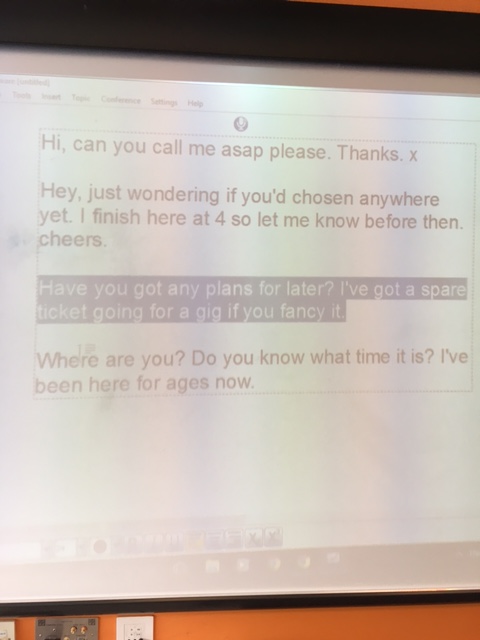
IMG_0414

  1. Hi. Can you call me asap please. x
  2. Hey, wondering if you’d chosen anywhere yet. I finish here at 4 so let me know before then. Cheers.
  3. Have you got any plans for later? I’ve got a spare ticket going for a gig if you fancy it.
  4. Where are you? Do you know what time it is? I’ve been here for ages now.

Do whole class feedback. Really go into detail.

Hi. Can you call me asap please. x

  1. This really troubled my class. They said work so I asked why. They said the polite question and the fact it was direct. I agreed but asked about the x. It was a name they said. I pointed out it meant kiss. So they came up with the idea that it might be a parent messaging a child with bad news. I was pretty happy with this explanation.
  2. Mine got that this was two friends arranging something. Cheers was interesting as they knew it in other contexts. We looked at whether there was a difference between Hi / Hey – concluding Hey could be seen as more friendly
  3. Some of my students decided that this was a guy inviting a girl out, which I liked as a possibility. We checked meaning of gig – one of the students was able to explain it.
  4. Mine didn’t get the repetition of the same thing as possibly being anger. Some did suggest it was to a friend as a joke, we discussed the potential for that to be misconstrued

I think the secret here is to really ‘demand high’ don’t let the students be lazy. Ask further questions, make them ask you questions. Encourage them to consider the connotations of the choices writers make.

2. Once you have gone through them all ask them in pairs to select two which they are going to reply to. Monitor and cajole. Again question what they want to say. For me, this was a great chance to prompt the students to use some of the TL, but also to fix register issues e.g. When i arrive – not wrong but is there a more natural way of writing this to a friend?

Additionally, it prepared me for things that could be highlighted for the whole class.

Then put some/ all of the student answers up onto the board. Ask which questions were being answered and how the person would feel receiving the reply. Highlight the examples of good language and fix what needs fixing through elicitation.

3. Finally, allow a few minutes for reflection. Ask the students to discuss what they feel was useful from the class; ask what they might now do differently. Highlight too that this was a chance to see them using new language and to provide an opportunity for them to use language they need for daily communication.


Set texts – go on, set a text!

So, CPE is the last one standing, the set texts having been taken away from the FCE and CAE exams as no one answered the questions on them.  Well, some of my students did, and even if they didn’t, reading the set text gave us the chance to practice lots of other skills as well as the obvious benefits of students reading.

When I first started teaching I encouraged my students to read and the first advanced class I taught we read a book together, I have also used audiobooks in class for extended listening practice.  To be honest, some of those were not so successful, but I think that was a failing with me as a teacher, I just wasn’t experienced enough to get the most out of the materials.  Last term I taught CPE, and we read Howards End by Forster and as well as note taking, building character profiles, discussing themes etc. we also did a variety of other things.

I’ve put ideas for some of them below, give them a go, they give the reading much more focus.

  • Turning a page of it into a part 1, 2, 3 Use of English, classic but reliable fall back and a chance to get the tip ex out! Or, if you are very smart try to copy and paste from a digital version.  With my last CAE class last year, I wrote summaries of the chapters and then made them into different parts of the paper.
  • Getting students to create their own reading parts of the exam, for example giving them a section and getting them to write multiple choice questions for it.
  • Cutting up the text and seeing if they can put it back into order using logical sequencing (you have to check that you can do this yourself).  Practices reading part 2
  • Showing the film of the book (if there is one) and getting the students to review it.  With the film there are obviously lots of opportunity to work on pronunciation as you already have a model to work from.
  • Summary writing of sections of the text will help them write concisely and learn how to paraphrase. Summary writing is also a necessary skill for CPEs.
  • Encourage students to make a set text dictionary, especially useful if they can list page numbers and example sentences, to help build vocab.
  • Do a Grammar hunt in a particular piece of text, students search for Conditionals, participle clauses, passives etc to build grammar awareness.
  • Vocabulary from the context, students match synonyms, practises scanning as well as building their vocabularies.
  • Rewriting some of it into a different register, for example if you have a book with rather formal text it can be fun to get them working in pairs to rewrite it in an informal way.
  • Using the direct speech for students to practice intonation and word and sentence stress, get them to record themselves, practice it, get them to think about changes in meaning depending on where the stress is and to think how it should be said, it is also really good to get students to think about where phrases should end and where they should breathe, for many, this is a real challenge and encouraging them to think about it can really help, especially if you do a little of this often.  Recording again after working at it gives students the opportunity to really see progress and who doesn’t like that?

Many students don’t want to read, so short stories or any form of text can be used for a lot of these activities, but I do think that for many students the satisfaction of reading a story and understanding it, along with the practice that they have put in by reading it can make a real difference to their confidence as well as level.

Just always remember to stress why it will be useful for them and what skills you are practising!